
Sports Ground Contractors in India Fail 80% of Grounds in 3 Years — Here's Why 4K Sports Doesn't
sports ground contractors knows, over 60% of sports grounds in India’s main cities that were constructed without engineered drainage during the most recent monsoon season experienced a loss of over 30 prime booking days due to waterlogging. That is not a sign of misfortune. That is the direct, quantifiable expense of employing the incorrect sports ground contractors.
Consequently, you are required to pay twice: once for the construction and again for the repair. For an excessively extended period, the term sports ground contractors has been associated with turf installers who install the green, collect the payment, and vanish before the initial rainfall reveals the subterranean materials they have concealed. You are entitled to superior treatment. Your investment, your community members, your employees, and your students deserve superior treatment.
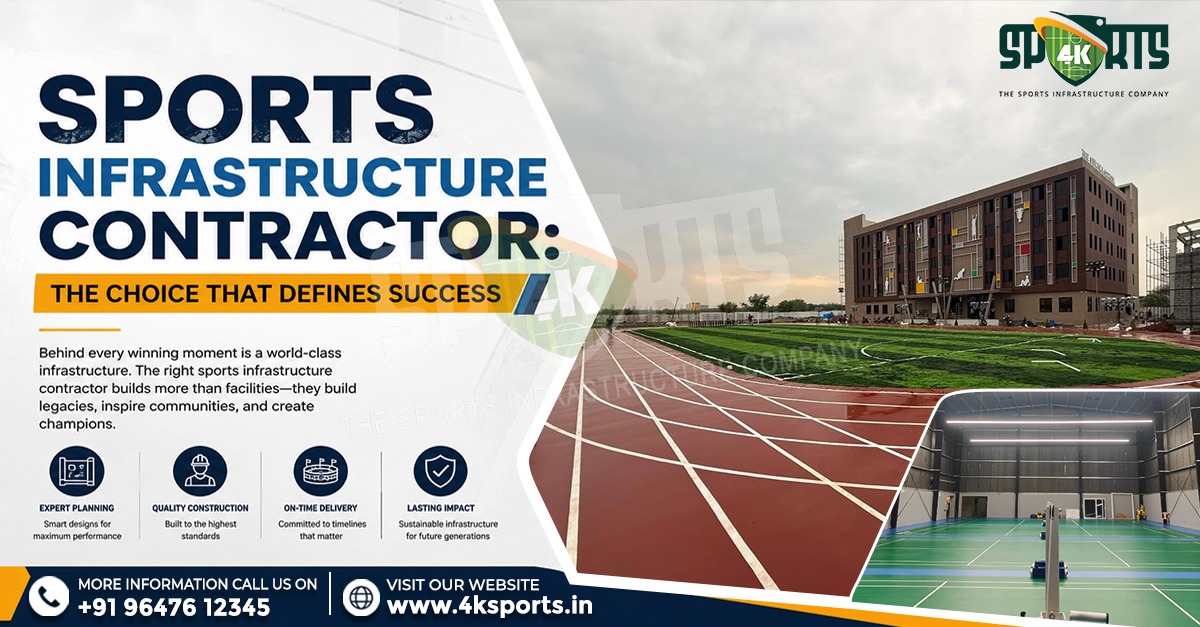
At 4K Sports, we specialize in the engineering of sports grounds, rather than the mere installation of surfaces. This guide demonstrates the standards we adhere to, the failings we avert, and the outcomes you can anticipate when you collaborate with a partner who is responsible for the entire project. We are the engineering-first sports ground contractors in India.
Sports Ground Contractors in Action: 3 Real Projects, 3 Measurable Outcomes
Prior to examining standards and specifications, let us consider the practical outcomes of such standards. These three projects illustrate the disparity between contractors who construct sports surfaces and those who design facilities. We can directly verify every outcome with the clients.
Case Study 1: Rehabilitation of a Flooded School Field — Bengaluru Challenge:
A prestigious international school in Bengaluru allocated ₹18 lakhs for a new football pitch, which transformed into a wetland within four months after installation. The initial sports ground contractor installed a level concrete base with no drainage gradient, resulting in all rainfall having no outlet. Physical education sessions were suspended for over 60 days throughout two rainy seasons. The lawn commenced delaminating due to rainwater accumulation beneath it.
4K Sports Infra Solution: 4K Sports performed a forensic site evaluation, excavated the compromised sub-base, installed a multi-layer WMM/GSB aggregate system compacted to 95% Proctor density, and designed a bespoke perforated-pipe drainage network graded at a 0.8% slope—verified by laser level prior to turf installation. The replacement turf was designed to include an anti-bacterial backing layer suitable for high-humidity conditions.
Result: The field has stayed arid and entirely playable through three successive monsoon seasons since the handover, facilitating uninterrupted physical education and competitive matches for over 800 kids. No incidences of waterlogging. No delamination. A facility that now operates as expected.
Case Study 2: Revitalizing a Corporate Multi-Sport Facility, Pune Challenge:
The recreation area of a prominent technology firm had seam cracking and surface undulation within 18 months of installation. The fundamental issue was that a subbase was compacted to merely 82% Proctor density, which is 13 percentage points below the professional requirement. The material sank unevenly under the weight of everyday use, causing the turf above to form ridges and troughs. The facility manager got official safety complaints from two employees who stumbled due to surface irregularities.
4K Sports Infra Solution: 4K Sports substituted the unstable base layers in segments, thereby preventing complete facility shutdown by executing the work in portions during non-peak hours. Each section was re-compacted to 95% Proctor density and checked with a laser to ensure it was less than 3 mm off level before installing the new FIFA-compliant multi-sport grass. The comprehensive remediation was accomplished in 22 days.
The result was a strong, perfectly level pitch that became the main focus of the company’s employee health program. The facility manager indicated no surface complaints in the 24 months following 4K Sports’ handover, in contrast to six official complaints in the preceding 18 months.
Case Study 3: Enhancement of a Government Community Complex, Kerala Challenge: A public sports facility in a coastal district of Kerala had algal proliferation on the playing surface, muddy bare areas in high-traffic zones, and persistent safety grievances from community users. The initial contractor specified conventional inland aggregate, which commenced deterioration after eight months due to Kerala’s coastal humidity and salinity. The drainage pipes were inadequately sized for the local rainfall intensity, resulting in the sub-base remaining soggy for 24 hours following heavy rain.
4K Sports Solution: 4K Sports has launched a marine-grade foundational system featuring sophisticated French drainage designed to accommodate the local rainfall coefficient. The substitute turf included anti-algal surface treatments and slip-resistant fibers designed for high-humidity applications. All fencing and fixture hardware was substituted with hot-dip galvanized steel suitable for coastal saline exposure.
The facility now accommodates uninterrupted year-round community leagues. The average downtime following rains decreased from 24 hours to less than 40 minutes, thereby safeguarding the league schedule and facility revenue. Two adjacent local authorities building new community sports facilities currently use the property as a reference installation.
Professional Sports Ground Contractors Provide Services That Turf Vendors Do Not
You are not merely purchasing a surface. You are purchasing a performance system that must safeguard your users, justify your investment, and endure for a decade or more without requiring constant maintenance. Consequently, the discrepancy between professional sports ground contractors and turf-only vendors is not a matter of quality preference; it is a matter of whether or not your facility functions properly.
Engineered for Day 1,000, Not Day One: A Durable Sports Turf Installation for Football
On the day of implementation, it is effortless to construct a football turf ground that is visually striking. The true test occurs 1,000 days later, when the Dtex rating of the fiber, the stitch rate of the backing, and the calibration of the SBR rubber particulate infill determine whether your surface continues to perform at the same level.
The majority of contractors concentrate on the color and height of the piles. 4K Sports concentrates on the system that lies beneath the fiber. We calibrate the infill ratio to the specific sport and intensity of use, select backing materials that are adequate for the local humidity, and engineer the sub-base to the correct California Bearing Ratio (CBR) for the soil type. The infill ratio consists of silica sand for stability and SBR or TPE granules for shock absorption. That is the distinction. The performance of a 4K sports turf ground remains consistent from year one to year five.
Installation of Sports Ground Fencing as a Structural Priority, Not a Finishing Detail
Your facility’s daily operations are contingent upon security and ball containment. Nevertheless, the majority of sports ground contractors regard the installation of sports ground fencing as the final item on their checklist. This fencing is simply bolted onto a completed surface without any integration into the civil design. The outcome is evident within a year: poles that sway under the tension of the net, anchors that draw from shallow concrete footings, and gates that are misaligned with drainage channels.
4K Sports incorporates fencing pole foundations into the civil design from the outset. During the base phase, our team pours deep concrete pilings, not after the surface is laid. In coastal regions such as Goa and Kerala, we recommend hot-dip galvanized steel. This material is capable of withstanding salt-air corrosion for 15–20 years, in contrast to the 2–3-year visible degradation timeline of untreated mild steel in the same environment.
Seamless, Safe, and Functional Interlocking Tiles for Multi-Use Zones in Sports Grounds
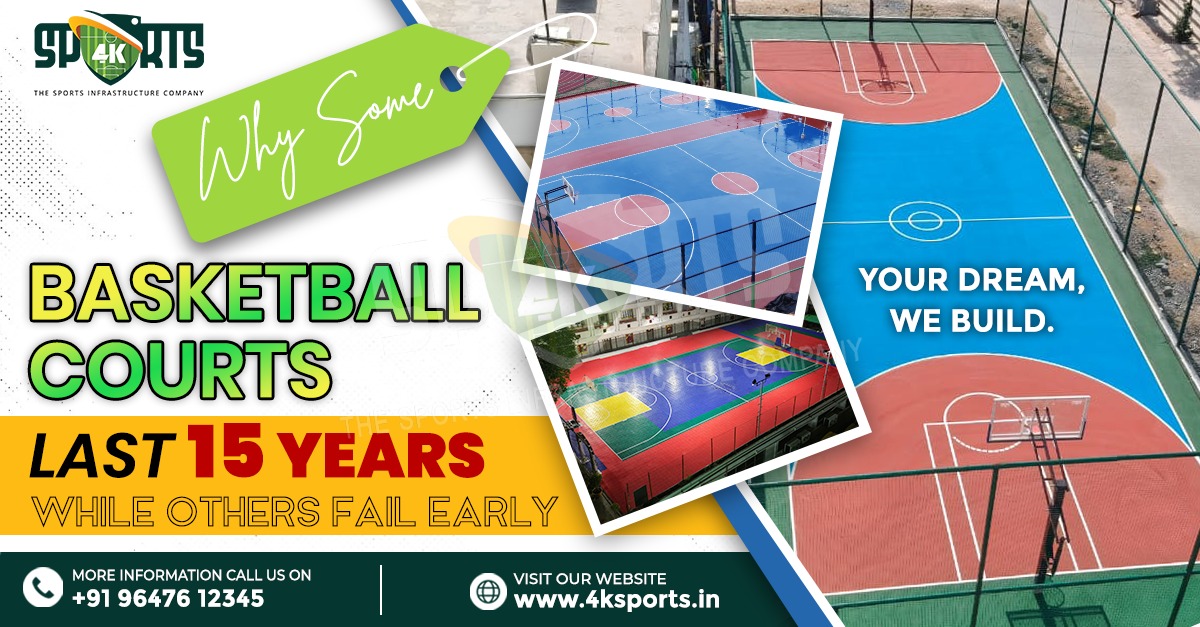
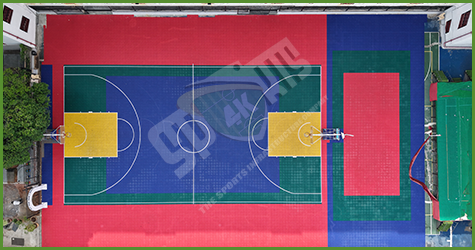
Your facility is rarely monofunctional, and it should not be designed as such. Additionally, if not designed properly, each transition zone between distinct surface types poses a potential accident hazard. 4K Sports incorporates high-performance interlocking tiles into the warm-up corridors of sports grounds, basketball zones, and multi-use areas adjacent to the main turf. This ensures that the level consistency across transitions is within the 4mm tolerance, which eliminates the trip risk in accordance with ISO 10545 surface flatness standards.
Sports Turf Installation: The 4K Sports Engineering-First Approach
Base-First Planning Prior to Sports Turf Installation
In more than 80% of the remediation initiatives that 4K Sports has evaluated throughout India, sub-base settling is the cause of sports ground failure. This implies that the decision regarding the material beneath the turf, which is made during the first week of a project, will determine whether the surface needs to be replaced in year three or year twelve.
We dedicate a minimum of two weeks to the base prior to the arrival of a single roll of turf at a 4K Sports site. In order to ascertain the California Bearing Ratio (CBR) and soil load-bearing capacity, we implement an exhaustive geotechnical survey. Subsequently, we develop a multi-layered WMM/GSB aggregate system and compact it to 95% Proctor density, which is confirmed by a laser audit of the entire surface area prior to the commencement of any other work. The end result is a foundation that ensures your sports turf installation remains flawlessly level for decades, rather than several seasons.
Climate-Responsive Design in Every Indian Region
The drainage specification that is effective in Rajasthan results in catastrophic subsurface saturation in Kerala due to the extraordinary climate range of India. A sports ground contractor who replicates the same design across multiple locations is not practicing engineering; rather, they are wagering with your investment.
4K Sports engineers drainage void ratios and perforated pipe diameters based on local rainfall intensity data. In high-rainfall regions such as Mumbai, Kochi, and Guwahati, we increase the pipe diameter by 40% over standard inland specifications. To prevent premature degradation of fibers under prolonged, high-intensity sun exposure, we choose turf polymers with a minimum UV stability rating of 2,500 hours in arid regions. In coastal regions, all metal components, including fencing poles and lighting structures, are hot-dip galvanized to prevent the corrosion that degrades standard mild steel within 18–24 months in salt-air environments.
Structured Quality Control System with Three Stages
4K Sports employs documented data in contrast to the majority of sports ground contractors, who rely on visual inspections such as “It looks flat enough.” It is not always the case that a surface that appears flat will function flat under load and play.
QC Stage | When | What 4K Sports Checks and How |
1 — Civil Audit | During base construction | 4K Sports verifies slope and planarity using laser equipment to a tolerance of <3mm across the full surface. Every result is documented. No surface material arrives on site until this audit is passed. |
2 — Material Audit | Pre-installation | 4K Sports lab-tests aggregate specification and turf parameters — Dtex rating, stitch rate, pile height, and infill California Bearing Ratio (CBR) — before any material is laid. Substandard material is rejected before it reaches your site. |
3 — Performance Audit | Post-installation | 4K Sports verifies ball roll and bounce behaviour against FIFA Quality Pro or FIH Global Licence specifications. Lux levels are measured at a minimum of nine court points. Client receives the complete audit documentation at handover. |
Turnkey Sports Ground Contractors: Single-Point Accountability Across All Sports
Hiring five independent vendors and relying on their coordination is the conventional method of sports ground construction. Contrastingly, 4K Sports eliminates the coordination risk wholly by serving as your exclusive sports ground contractor throughout the entirety of the project. You execute a single contract. You converse with a single project manager. If the drainage system fails to operate effectively, 4K Sports resolves the issue. 4K Sports rectifies any deficiencies in lighting specifications. There is no disagreement among vendors regarding the responsibility of the situation, as there is only one vendor.
Single-Point Accountability Model
In over 40% of Indian sports ground projects, revision costs of 30–50% of the original contract value are generated by fragmented vendor projects, in which civil, fencing, electrical, and surface contractors operate independently. This information is derived from 4K Sports’ forensic assessments of failed facilities. The rationale is structural: errors accumulate when trade interfaces are unregulated. The civil team pours a base that lacks the drainage outflow positions that the fencing team requires. Conduits that interfere with the structural team’s column footings are routed by the electrical team. 4K Sports eliminates each of these interface risks by utilizing a single, integrated design for all trades.
Coordinated Civil, Surface, and Lighting Execution
Every trade is coordinated in real time by 4K Sports, rather than retrospectively. In particular, our electrical engineers collaborate with civil supervisors to install underground conduits prior to the sealing of the base, thereby avoiding the costly and destructive process of carving channels through cured concrete after the fact. During the civil phase, our structural team pre-installs lighting pole foundations to ensure that the poles arrive on site to completely cured and load-ready footings. Your 4K Sports project manager updates a single master project plan on a weekly basis, which is used to sequence each trade.
Risk Reduction Through Phased Planning
Furthermore, 4K Sports organizes each project into five distinct, auditable phases: Design, Civil, Structural, Surface, and Finishing. This phased approach identifies impediments prior to their transformation into delays, rather than afterward. For example, 4K Sports prioritizes the drainage installation in the initial phase of civil work if a monsoon is anticipated within six weeks of the project’s commencement, thereby guaranteeing that the site is functional regardless of rainfall. Your timeline and budget are safeguarded from the most disruptive variable in Indian sports ground construction by that singular sequencing decision.
Sports Turf Installation: The 4K Sports Engineering-First Approach
Professional Sports Turf Installation Surface Systems
The surface is the point of contact between the facility you have constructed and your participants. Consequently, the safety of your users and the performance quality of your facility are directly and measurably impacted by each specification decision made in professional sports turf installation, from the Dtex fiber rating to the SBR granule infill ratio.
Artificial Grass for School Sports Ground: Safety as the Engineering Brief
Injury prevention is the primary design constraint at your institution, rather than aesthetics, cost, or convenience. The G-max rating of the playing surface, which is the measure of maximal impact force during a fall, directly determines whether your students are cushioned by a compliant surface system or suffer concussion-level impacts.
4K Sports requires a shock pad underlayment to be installed on every school installation. This prefabricated layer mitigates the G-max rating of the surface to less than 100 g, which is the threshold at which FIFA and EN 14904 standards designate a surface as presenting an elevated concussion risk. At the time of handover, we ensure that all materials are skin-safe and non-toxic, as they are certified in accordance with REACH regulations. Additionally, we furnish the complete material safety data document. The outcome is that your pupils are able to play on a surface that is significantly safer than the majority of school grounds in India.
Shock-Absorbing Sports Turf Engineering for Performance Facilities
Unlike school facilities, where injury prevention is the primary concern, performance facilities necessitate a distinct turf specification. This specification must ensure that the athlete receives energy return without exposing their joints to excessive peak loading. A surface that is excessively soft induces fatigue, while one that is excessively firm induces injury. The precise specification is contained within a restricted range.
4K Sports determines the precise ratio of silica sand (for structural stability and consistent ball roll) to SBR or TPE rubber particles (for shock absorption and player comfort) for each facility by considering the sport, the intensity of usage, and the target user profile. The defining characteristic of FIFA Quality Pro and FIH-licensed playing surfaces is a pitch that is forgiving for the player but feels rapid for the ball. This is the result of the calculation.
Interlocking Tiles for Sports Ground Multi-Use Areas
Your facility’s multi-use zones, including warm-up corridors, basketball courts, and skating areas, necessitate a surface that can withstand heavy foot traffic, drains instantaneously, and transitions safely to the main turf without generating trip hazards. This is in addition to the main playing surface. 4K Sports incorporates interlocking tiles for multi-use areas on sports grounds that are engineered to a transition height tolerance of less than 4mm. This threshold is the point at which ISO 10545 classifies a surface-level change as a trip risk. These porous, high-durability tiles are available in high-visibility colors and are designed to meet the same anti-UV standards as the contiguous turf system, ensuring that your entire facility ages in a consistent manner.