
The initial competitive encounter on a new court is a moment that every facility manager dreads.
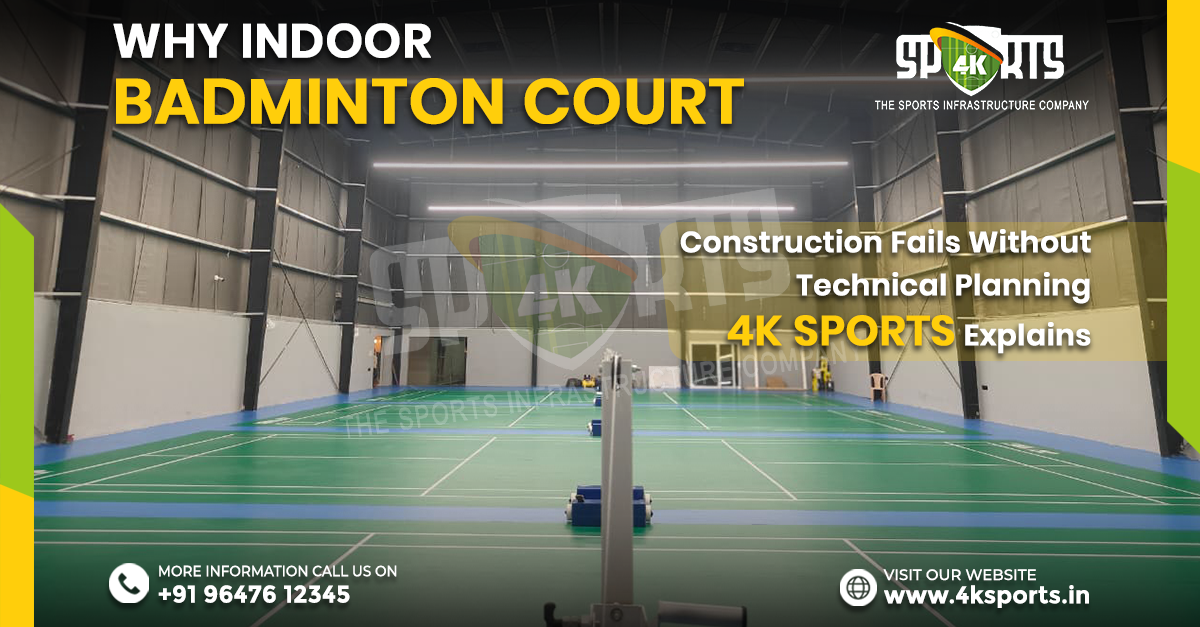
The participants observe it before any other individual. The landing of a lunge, which is intended to be cushioned, is harsh on a concrete surface that is situated beneath a thin mat. A high clear strikes the rafters just three meters from the back line. A serve vanishes into the white wall behind the server, obscured by the brilliance of the background. Under the brilliant new lights, each player’s eyes are averted upward.
These are not ornamental issues. Engineering failures are the direct result of considering badminton court construction as a civil task rather than a technical one. They are all avoidable and predictable.
4K Sports has conducted an extensive evaluation of numerous unsuccessful indoor facilities throughout India and has determined that 80% of badminton courts constructed without the assistance of specialized planning fail to meet the standards of professional play. The structure continues to exist. The floor reflects light. The boundaries are painted. However, the shuttlecock pierces the ceiling, the players’ knees ache, and the evening reservations never materialize because serious players are aware of the substandard court within ten minutes.
A badminton court is not simply a floor; it is a complex technical ecosystem. It is a technical ecosystem.
This guide delineates the precise requirements of that ecosystem and the way in which 4K Sports engineers it, from the moisture barrier beneath the sprung floor to the photometric plan that ensures that each light fixture is positioned at the appropriate angle above the sidelines. Three client initiatives that have been verified attest to these claims. Any contractor can be assessed against the technical specifications, which are sufficiently detailed. Prior to placing the initial masonry, review this document.
4K Sports Technical Standard: The Actual Requirements for Professional Indoor Badminton Court Construction
1. Prior to the structural design being sealed, a minimum clear height of 9 meters is established, with all overhead services coordinated concurrently.
2. Concrete slab moisture testing (maximum 2.5% content) prior to the installation of any timber sprung floor system
3.5-layer timber sprung floor system featuring a vapor barrier, resilient pads, pine battens, plywood decking, and a BWF-approved maple/teak surface
4. Photometric lighting plan: fixtures are positioned along the sidelines, never above the courts; the lux is verified at nine measurement locations.
5. Acoustic treatment: baffles are designed to produce a delay of less than 1.5 seconds. RT60 reverberation time for the purpose of enhancing the clarity of play and instruction.
The court features laser-guided millimeter precision, BWF-compliant dimensions, safety run-off zones, and anti-slip line marking.
What 4K Sports Actually Delivered: Three Courts, Three Technical Rescues
Consider three actual facilities prior to specifications and standards. Each was constructed by proprietors who desired something exceptional, but each was initially disappointed by contractors who failed to recognize that badminton court construction is a specialized field.
Project 1: Victory International Academy — Conversion of an Auditorium
The Circumstances: The school had a sizable, underutilized multipurpose auditorium that was plagued by a critical issue: the clearance height had decreased to five meters at the sides, rendering it impossible to achieve lofty clearances on the outer courts. The concrete floor was an echo chamber that rendered coaching inaudible due to its weak acoustic properties. The current surface was generic synthetic matting, which resulted in joint pain during protracted play.
What 4K Sports Did: 4K Sports conducted a structural feasibility audit and determined that a mid-span truss modification could increase the effective clearance to 8.2 meters, which is sufficient for club-level play. 4K Sports installed acoustic baffles that were calibrated to achieve a reverberation time of less than 1.5 seconds, a 5-layer dual-moisture-barrier wooden sprung floor, and BWF-compliant LED illumination that was positioned along the sidelines at 500 lux.
What Changed: The academy conducted its inaugural district-level tournament during the subsequent season. There have been no complaints regarding flooring or safety in the twelve months following the transition. The number of students who participated in badminton doubled.
Project 2: V-Tech IT Park, Hyderabad — Courts for 2,000 Employees
The Situation: The corporate wellness team required courts that could accommodate competing after-work competitions, morning training sessions, and weekend family events simultaneously. Due to the spatial constraints, it was necessary to optimize each square meter. Additionally, the management required a lighting system that could accommodate casual recreational participants at a reduced intensity without consuming excessive energy during off-peak hours.
What 4K Sports Did: 4K Sports oversaw the project from the initial 3D layout planning, which involved the integration of four courts with the appropriate safety run-off zones into a constrained footprint, to the development of a programmable LED array that enabled facility managers to regulate the lux levels by zone and time interval. A wooden sprung floor that is shock-absorbing and designated for high-frequency multi-use traffic was installed in accordance with the BWF specification.
What Changed: The programmable LED system reduced electricity consumption by 23% in its first quarter when compared to the fixed-output estimate. Participation in employee athletics increased by 35%. Since the transition, there have been minimal maintenance requirements.
Project 3: Community Hall Retrofit for the Green Meadows Residents’ Welfare Association
Situation: For the previous two years, the community hall had been equipped with rudimentary overhead lighting and generic synthetic mat flooring. After sessions, players reported experiencing joint pain, slippery line markings, and low-light conditions that made it challenging to trace the shuttlecock. The facility was facing an increase in safety complaints and a decrease in usage.
What 4K Sports Did: 4K Sports replaced the synthetic mat with a maple wood sprung floor system. First, the slab was moisture-tested, and an epoxy barrier was installed in areas where the readings exceeded the 2.5% threshold. The illumination was relocated from overhead to sideline-mounted LED fixtures with anti-glare diffusers. Anti-slip polyurethane line markings were implemented in accordance with the BWF specification. To prevent condensate on the new surface, ventilation was optimized.
What Has Changed: Weekend leagues and children’s coaching programs are currently at capacity. The number of injury incidents has decreased significantly. The post-retrofit satisfaction survey revealed a 90% increase in user experience scores. The hall, once in decline, is now fully booked two weeks ahead.
The Technical Failures That Destroy Badminton Courts Prior to the First Tournament
The ribbon-cutting ceremony of the majority of indoor badminton court constructions conceals the majority of construction failures. The structure appears to be finished. The floor is immaculate. The lines are well-defined. The server is blinded by the lighting on the first evening of competitive play, the shuttle hits the roof on a genuine high clear, and the floor bounces unpredictably due to the moisture beneath it, which has already begun warping the boards. These issues are first revealed.
4K Sports has identified three categories of failure, each of which has a distinct engineering cause and a preventable solution:
Failure Category 1: The Warehouse Mentality
The most prevalent cause of failures in badminton court construction is a contractor who constructs a generic shed and then attempts to convert it for badminton. The outcome is a facility that failed to take into account the principles of badminton during the design process.
• Standard HVAC ventilation generates airflows that significantly influence the flight path of a 5-gram shuttlecock. 4K Sports employs low-velocity displacement ventilation or fabric ducting, which ensures that cool air enters at the perimeter floor level, exits at the ridge, and never traverses the court at shuttlecock height.
• Background contrast failure: A white shuttlecock is rendered invisible against the background due to the presence of white walls and daylight-facing windows. The contrast that renders the shuttle trackable at 400 km/h is specified by 4K Sports as non-reflective wall colors in the dark green or navy range behind baselines.
• Acoustic chaos: The incessant echo is physically exhausting, and coaches and players are unable to communicate due to the reverberation times of 3–5 seconds caused by bare shed walls. Ceiling baffles and upper-wall absorption panels enable 4K Sports to attain an RT60 of less than 1.5 seconds.
Failure Category 2: Inaccurate Clearance Height
The clearance height requirement for badminton court construction is non-negotiable and is frequently misconstrued. The Badminton World Federation requires a minimum of 9 meters of clear, unobstructed height above the complete court area for international play and 7 meters for club-level play. The critical term is unobstructed.
4K Sports frequently evaluates facilities in which the roof peak exceeds 9 meters, but the practical clearance over the outer courts is reduced to 6.5 or 7 meters after the installation of lighting fixtures, HVAC ducts, and structural beams. The outer courts are structurally intact but functionally unusable for competitive badminton. 4K Sports resolves this issue by designing all overhead services in 3D prior to the finalization of the structural design, thereby contractually guaranteeing the clearance envelope rather than estimating it after the roof has been sealed.
Design preferences are not determined by height. It is a prerequisite for the physics course.
Failure Category 3: Floor Friction and Precision of Line Marking
The necessity of millimeter precision in badminton court line-marking services is not due to the fact that tournament officials carry measuring tape but rather because a line that is 42 mm wide instead of the BWF-mandated 40 mm alters the ‘in’ and ‘out’ calls that determine the outcome of competitive matches.
The texture of the line is a safety concern in addition to its breadth. Standard oil or acrylic paint produces a surface that is measurably more slippery than the surrounding floor. The ankle fails to recover in time when a player lands on a slick line while lunging at maximum speed. 4K Sports exclusively applies anti-slip polyurethane paint that is laser-guided to ±1 mm and matches the friction coefficient of the floor beneath it after the surface has completely cured.
What Proper Indoor Badminton Court Construction Actually Requires
A professional badminton court is a technological sandwich, consisting of five layers of engineered materials that collaborate to safeguard the player, provide optimal performance, and endure for a minimum of two decades. Understanding each layer is crucial to grasping why 4K Sports’ approach is more expensive than a concrete foundation with a mat and how this cost difference accumulates over a decade, resulting in overall savings.
The 5-Layer Wooden Sprung Floor is specifically designed for badminton.
The playing surface is the point at which physics and physiology intersect. Shin splints, knee discomfort, and chronic ankle stress accumulate session by session as a result of the direct transmission of every landing impact to the player’s joints by a concrete floor covered with synthetic matting. A wooden sprung floor that is properly engineered for badminton offers “area elasticity,” which is the floor’s ability to slightly deflect under impact. This wider area distribution of force enables the player to receive the energy instead of the structure absorbing it.
Layer | Component | What 4K Sports Specifies and Why It Cannot Be Skipped |
1 | Vapour Barrier | A continuous polyethylene membrane laid directly on the concrete slab. 4K Sports moisture-tests the slab first — if moisture content exceeds 2.5%, an epoxy barrier replaces the standard membrane. This is the most commonly skipped step in Indian installations. |
2 | Resilient Pads | Engineered rubber or elastomer cushions positioned at precise intervals — the spacing determines the floor’s shock absorption profile. 4K Sports calibrates pad density for the specific usage intensity of each facility. |
3 | Pine Wood Runners (Battens) | A precisely spaced batten system that creates the structural framework above the resilient pads. The spacing determines the flex response of the finished floor. |
4 | Plywood Decking | Two layers of structural-grade plywood creating a stable, dimensionally consistent deck. 4K Sports leaves specified expansion gaps — wood breathes with humidity, and those gaps prevent buckling. |
5 | Surface Board (Maple or Teak) | The playing surface — a tongue-and-groove hardwood layer finished with sport-specific varnish. 4K Sports uses only BWF-approved species and finish systems rated for indoor racquet sports. |
Scientific Badminton Court Lighting Installation.
The task of lighting a badminton court is technically more challenging than that of illuminating a football pitch. This challenge is due to the fact that badminton players spend half of the game gazing vertically upward into the fixture zone. The installation of badminton court illumination at 4K Sports commences with this constraint and proceeds in reverse order to the fixture specification.
Each 4K sports lighting design commences with a photometric study, which is a software model of the hall that forecasts the luminosity distribution from various fixture positions prior to the ordering of a single unit. Next, all fixtures are positioned along the sidelines, angled inward and downward across the court at a precisely calculated angle that ensures uniform lux distribution without positioning any light source in the visual field of a player executing an overhead stroke.
• Training and educational facilities: an average of 500 lux with a uniformity variation of less than 20% across the court surface.
• Club and state competition: a minimum of 750 lux, uniform distribution, and anti-glare diffusers on all fixtures.
• The standard 4K sports at V-Tech IT Park were attained with the programmable LED system, which reduced energy consumption by 23% and provided 1,000+ lux with less than 15% uniformity variation for the tournament and broadcast.
Photometry is not a luxury. It is the distinction between a facility that serious athletes frequent and one that they avoid.
Moisture Control and Sub-Base Preparation
Wood respires. It expands in humid environments and contracts in dry temperatures. The most costly failure mode in indoor badminton court construction in India is caused by this straightforward material property, which is also the most frequently disregarded.
Before any flooring system is implemented, 4K Sports evaluates the moisture content of each concrete slab. If the moisture reading exceeds 2.5%, which is the threshold at which wood begins to absorb ambient moisture and deform, 4K Sports applies a specialized epoxy moisture barrier to the entire slab surface before the vapor layer is installed. This results in an increase in expenses. It also prevents the situation in which a ₹20 lakh wooden floor warps, cups, and buckles within six months, resulting in a ₹15–20 lakh remediation bill and months of facility downtime.
The moisture test is priced at a few thousand rupees. The cost of neglecting it is in the thousands.
The Complete Technical Specification: What 4K Sports Delivers as Standard
The technical parameters outlined below are the minimum standard that 4K Sports applies to all indoor badminton court construction, irrespective of the project’s scale. These parameters are not considered premium options.
Technical Parameter | BWF / EN Standard | 4K Sports Delivery Standard |
Clearance Height | Min. 9 m (competitive); 7 m (club/recreational) | 4K Sports plans all overhead MEP services before structural design — the 9-metre envelope is a contractual guarantee, not a post-construction measurement |
Court Dimensions | 13.4 m (L) × 6.1 m (W) per court | 4K Sports surveys to ±1 mm using laser equipment before line marking begins |
Safety Run-Off | Min. 1.5 m between courts; 2 m at baselines (competitive) | Cramming 5 courts into a 4-court space creates collision hazards — 4K Sports optimises layout before civil design is frozen |
Lighting — Club Level | 500–750 lux, uniform, parallel to sidelines | 4K Sports produces a photometric plan before fixture specification; lux verified at 9 court points at handover |
Lighting — Tournament | 1,000+ lux with <15% uniformity variation | Positions all fixtures along sidelines — never above the court — to eliminate the glare that blinds servers |
Floor Moisture Tolerance | Max. 2.5% moisture content in concrete slab | 4K Sports moisture-tests every slab before flooring begins; epoxy barrier applied if threshold is exceeded |
Line Width | Exactly 40 mm — not 38 mm, not 42 mm | Anti-slip polyurethane paint applied after surface is fully cured; laser-guided for millimetre precision |
Acoustic Reverberation | <1.5 seconds RT60 for coaching clarity | 4K Sports specifies acoustic baffles on ceiling and upper walls — preventing the echo chamber effect of bare shed construction |
The Turnkey Advantage: Answering the Questions Every Client Asks
Every client contemplating turnkey badminton court construction at 4K Sports expresses the same three concerns. The following is the genuine response to each question: It is not a sales pitch but rather an engineering actuality.
Is turnkey more expensive?
Yes.
The drainage pipe position, the light pole foundation, the acoustic baffle load, and the court layout are all integrated into a single, coordinated design in a comprehensive project. The “coordination tax” is the cost of errors at the handover zones between trades, which is a result of a fragmented project that includes a distinct civil contractor, a separate flooring vendor, and a separate electrician. The drainage conduit is situated precisely where the net post anchor is required. The electrician excavates channels through the completed floor to install conduits that were intended to be interred during the civil phase. By administering each transaction from a single, integrated design, 4K Sports eliminates all of these interface costs.
Inexpensive construction is costly. The invoice is received at a later date, and it includes compound interest.
Would it be possible to convert an existing hall into a sports facility?
Certainly, but only after conducting an honest audit.
4K Sports is a company that specializes in the evaluation of structural feasibility in existing spaces. To verify that the column grid can accommodate full-width courts without court-edge pillars, we conduct an analysis. We calculate the effective clearance height after taking into consideration all current services. The moisture content and load-bearing capacity of the floor slab for the sprung-floor substructure are evaluated. 4K Sports constructs the most optimal facility feasible within the confines of the space, provided that it is operational. 4K Sports will inform you directly if the space is not suitable for competitive badminton, rather than constructing a substandard court that disappoints from the first session.
The most valuable service that a specialist contractor offers is an unbiased feasibility assessment.
What is the actual clearance height that is required
For a recreational facility within a gated community, a clearance of 22–24 feet (6.7–7.3 meters) is feasible for casual play, with some restrictions on high clearances. The minimum requirement for a coaching academy or institution that intends to host district matches is 30 feet (9 meters) of completely unobstructed height above the full court area. It is important to note that “9 meters at the peak” does not necessarily equate to “9 meters of clear height above the courts.”
Before finalizing the structural design, 4K Sports models every proposed facility in 3D. This ensures that the effective clearance height above every court position, after all overhead services, is verified on screen. The cost of discovery during construction is substantial. There is no cost associated with discovering a 3D model.
What Is Changing in Indoor Badminton Court Construction in 2026
4K Sports does not monitor these trends remotely; rather, we implement them in real-time client initiatives. Each innovation listed below has a completed installation to its credit.
Programmable LED Lighting Systems
The use of metal halides for badminton court lighting is nearing its end. Facility managers can conserve energy by dimming courts during warm-ups and maintenance, and they can instantaneously achieve a broadcast-quality 1,000 lux for a tournament final using programmable LED arrays that can be controlled by zone and intensity via a mobile app.
In the first quarter, 4K Sports implemented programmable LED arrays at V-Tech IT Park, which resulted in a 23% reduction in electricity consumption while maintaining exceptional playing conditions during all times. Anti-glare diffusers that were particularly designed for racquet sports, where players gaze directly into the fixture zone, were specified for each position in the sideline array.
Progressive Shock Absorption in Sprung Floor Systems
Progressive shock absorption is now available in next-generation composite substructures. These substructures are designed to be softer for the impact of a child during a coaching session and firmer for the leap smash of a senior professional during a national qualifier. After one full season of school tournaments, 4K Sports piloted a next-generation modular sprung floor system with advanced elastomer padding at Victory International Academy. Injury reports decreased to nearly zero, and coaches observed a consistent, predictable bounce across all age groups.
The modular design also simplifies maintenance scheduling, as it allows for the replacement of individual damaged sections without the need to disassemble the entire floor system.
Performance Monitoring Infrastructure Driven by Artificial Intelligence
Because the cost of retrofitting cabling into a completed facility is four to five times higher than constructing it from the beginning, high-specification indoor sports hall developers are now incorporating camera and sensor infrastructure into the building structure during construction.
4K Sports implemented a monitoring system that was AI-driven and connected to the hall display and mobile coaching interfaces at the Green Meadows Residents’ Welfare Association. This system monitored player footwork patterns, rally duration, and shuttle speeds. Coaches reported that technique development occurred at a significantly faster pace. The data-driven training programs that the system facilitated resulted in a substantial increase in member engagement for the club.
Maintenance Protocol for Indoor Badminton Courts
When properly maintained, a wooden sprung floor for badminton can last for 20 years, making it a long-term asset. Upon delivery, 4K Sports furnishes each client with a personalized maintenance manual.
The following schedule is the standard protocol for all 4K Sports installations:
Frequency | Maintenance Tasks |
Weekly | Sweep and dry-mop the court to remove dust, sweat residue, and debris. Check for moisture on or near the flooring — early detection of leaks or condensation prevents costly warping. Inspect for loose boards, abnormal flex underfoot, or scuff marks. Clean scuffs using only manufacturer-approved wood-safe products. |
Monthly | Conduct a full floor inspection for minor wear, micro-scratches, and signs of dampness near expansion joints. Verify HVAC and dehumidification systems are maintaining the correct humidity band. Inspect all lighting fixtures and replace any failing units to maintain lux uniformity. Check door seals and window closures for air-draft intrusion. |
Quarterly | Deep clean and gentle recoat of high-traffic areas (net post zones, baseline centres). Inspect all wall padding, net posts, and tensioning hardware for structural integrity. Review acoustic performance — new echoes indicate displaced or damaged baffles. Test anti-slip properties of line markings. |
Annually | 4K Sports professional inspection: full floor integrity audit, moisture content test, lux verification at 9 court points, BWF compliance review. Deep clean and full surface recoat if required. Service all lighting control panels (especially programmable LED systems). Audit fire safety and compliance documentation. |
• There is a single rule that is more important than all others: only use cleaning agents that are particularly recommended for the floor’s finish system. Water accumulation and the use of household detergents disintegrate the friction coating that makes the floor suitable for play.
• Shoe policy is significant: the introduction of abrasive particulates that degrade the finish and the acceleration of surface wear when outdoor or rubber-soled shoes are worn on hardwood. 4K Sports suggests that a specific indoor court shoe policy be implemented from the very first session.
• Maintain the incident log: the most valuable dataset a facility manager possesses is a record of maintenance activities and player complaints, as it predicts the need for the next professional inspection and validates warranty claims.
The Method 4K Sports Uses to Ensure the Technical Accuracy of Each Project
4K Sports does not make assumptions and makes adjustments. Before proceeding to the subsequent stage, we conduct measurements, modeling, and verifications.
• Site Audit and Feasibility: Prior to issuing a quotation, 4K Sports evaluates the wind orientation for natural ventilation, the soil stability of the structural foundation, the sun path for window and opening positions, and the effective clearance height with all planned overhead services. Before a single rupee is spent, the client is provided with a 3D model of the facility to visualize the precise sightlines, traffic flow, and court layout.
• Only Certified Materials: 4K Sports specifies BWF-approved flooring species and finish systems, LED fixtures graded for racquet sport photometry, and acoustic baffles calibrated for the specific hall volume. Substitutions are prohibited without written client authorization.
• Expansion Gap Precision: Hardwood experiences expansion and contraction as a result of humidity fluctuations. The installation team at 4K Sports is well-versed in the precise expansion gaps that are necessary for each flooring species within the hall’s anticipated humidity range. Gaps that are too small can result in bowing, while spaces that are too large can cause rattling during activity.
• A Warranty That Matters: The warranty is not divided among the flooring vendor, the electrician, and the civil contractor because 4K Sports oversees the entire construction process. A single warranty. A single organization is accountable. A single telephone number.
Commonly Asked Questions Regarding Indoor Badminton Court Construction
1. Which wooden sprung floor is the most suitable for indoor badminton court construction in a school?
4K Sports recommends a maple wood surface on a dual-layer batten system with resilient elastomer cushions for schools. This design offers high durability for multi-purpose use and provides shock absorption to safeguard developing joints. The entire system is certified and BWF-approved. The G-max impact test result is provided by 4K Sports at the time of handover, which confirms that the floor satisfies the safety threshold for student use.
2. What is the prescribed clearance height for professional badminton courts in India?
For competitive and international play, the BWF requires a minimum clear height of 9 meters (30 feet) above the complete court area. This measurement is taken from the lowest obstruction, such as a lighting fixture, duct, or beam, rather than the roof apex. Clubs and recreational facilities are permitted to operate at a height of 7 meters, subject to certain restrictions regarding the height of the clear. 4K Sports contractually guarantees the clearance envelope by planning all overhead services prior to the completion of the structural design.
3. What is the method by which comprehensive badminton court construction reduces long-term maintenance costs?
4K Sports’ complete badminton court construction combines the moisture barrier, sprung floor support, MEP services, and soundproofing into one well-planned design, which avoids problems that can lead to expensive issues like warped floors from untested slabs, lights needing to be moved after being installed, and drainage systems interfering with net post anchors. Nothing necessitates costly repairs when retrofitting is not implemented.
4. Would it be possible to transform an existing warehouse into a space for installing an indoor badminton court?
Certainly, 4K Sports can conduct a structural feasibility audit. The important checks include making sure there is enough height after adding all the overhead services, that the column layout works with the full-width court design, and that the slab’s moisture level and strength can support the sprung-floor base. Before the lease or construction contract is signed, 4K Sports will provide an honest assessment of whether the space is suitable for the level of play you intend to host.
5. Do indoor sports hall developers address HVAC planning and structural load considerations?
Indeed. Before the structural engineer completes the design, 4K Sports calculates the structural stresses for PEB sheds and civil structures, which include suspended lighting arrays, HVAC ductwork, acoustic baffles, and maintenance catwalks. Displacement ventilation principles are employed to specify HVAC systems in order to eradicate court-level air drafts that disrupt shuttlecock flight. Both are designed prior to the commencement of construction rather than being retrofitted afterward.
6. What is the impact of professional badminton court line marking services on the efficacy of players?
To ensure that a player who steps on a line during a quick lunge lands with the same grip as the adjacent floor, professional badminton court line marking services employ anti-slip polyurethane paint that matches the friction coefficient of the surrounding floor. Standard acrylic or oil paint produces a measurably fluid surface on the line. 4K Sports has never applied all line markings laser-guided to ±1 mm after the floor has entirely cured.
A Court That Is Worth Playing On: The Standard 4K Sports Build
Return to the initial moment: the inaugural competitive match on a new court. Now envision the identical situation, with the exception that each decision in this guide was implemented during the design phase.
The competitors enter the court. There is a slight amount of give in the floor during each landing, which is sufficient to cushion the knees while also retaining sufficient energy to propel the next explosive step. A high clear travels to the back line and drops cleanly inside the court, achieving the shuttle’s unobstructed 9-meter clearance and uninterrupted trajectory. The server gazes upward and observes a sideline-mounted array that illuminates the entire court at 750 uniform lux without a single glare point in the overhead field of view, rather than a dazzling fixture. The coach’s instruction is audible throughout the hall. The duration of the reverberation is 1.2 seconds. After landing, the sound dissipates.
From the inside, that is how badminton court construction should feel. Regardless of the size of the facility, 4K Sports incorporates that experience into every project as the minimum standard, rather than as a premium option.
A badminton court is an example of a technical ecosystem. 4K Sports meticulously designs the badminton court from its foundation.
Are you prepared to construct a court that is worthy of playing on?
4K Sports provides comprehensive indoor badminton court construction services throughout India, including BWF feasibility audits, 3D layout planning, sprung floor engineering, photometric LED lighting, acoustic treatment, and full compliance handovers. A single contract. A single technical standard. Twenty-year asset.