
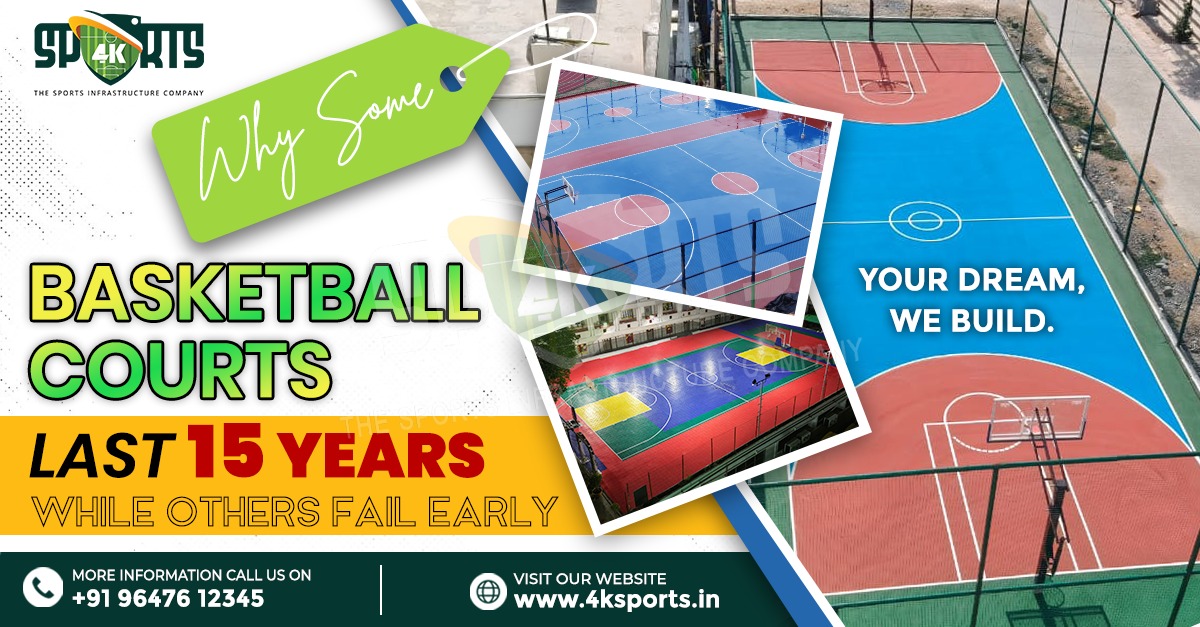
Why do some basketball court construction in India still play well after 15 years, while others crack and fail within five? The answer is not the paint on the surface. It is what sits under it.
This guide explains how basketball court construction India actually works — from soil testing and drainage planning to surface choice, contractor selection, and long-term maintenance. This blog is for schools, residential communities, sports clubs, corporates, and real estate developers planning a court that earns its space for the long run.
The pages ahead cover what makes a court last, what makes one fail, how to choose the right partner, and how to avoid the mistakes most owners discover too late. No buzzwords. Clear answers.
What makes a basketball court last longer? • Proper site preparation • Strong foundation design • Effective drainage system • Correct surface selection • Quality construction execution • Regular maintenance • Experienced contractor involvement |
The Hidden Reason Some Basketball Court Construction In India
Ask most people why a basketball court construction in india fails early, and they will say the paint wore out. That is the visible symptom. It is rarely the actual cause.
A court’s lifespan is decided long before the first coat of acrylic touches the surface. It is decided by the soil, the base, the drainage, and the structure that supports them.Owners often assume that picking a good paint or a famous flooring brand will solve everything. It will not. A perfect surface on a weak base will fail just as fast as a poor surface on a poor base.
The courts that play well for 15 years share a few things in common. The site was tested. The base was engineered, not improvised. The drainage was planned, not added later. The contractor knew sports surfaces, not just civil construction. Most early failures happen because one or more of these foundational steps was skipped to save cost or time. This guide walks through each of them.
Basketball court construction in India Starts Below the Surface
Importance of Site Assessment
Every basketball court construction India project should begin with a site visit — not a drawing. The team needs to walk the ground, measure it, and understand how water moves across it during rain.
A good site assessment looks at orientation (sun direction), nearby buildings, tree shade, slope, and access for trucks. These small details shape the design more than most owners expect.
Soil Testing and Ground Conditions
Soil testing tells you what the ground can hold. Without it, you are guessing about the foundation. Settlement cracks and uneven surfaces almost always trace back to a skipped soil test.
In black cotton soil regions, special treatment is needed because the soil expands and shrinks with moisture. In rocky soils, the approach is different again. A one-time test prevents long-term damage.
Drainage Planning Before Construction
Drainage is the single most overlooked factor in outdoor basketball court construction India. Water that cannot escape ruins both the surface and the base over time.
Plan the drainage before you pour any concrete. The court should have a slight slope (typically 1 in 100) so water runs off, and channels around the edges to carry it away cleanly.
Pre-Construction Planning Checklist
- Soil test report obtained and reviewed
- Site survey and orientation study completed
- Drainage plan designed (with slope and channels)
- Load-bearing capacity confirmed
- Access roads identified for construction trucks
- Local permissions and approvals applied
- Court dimensions confirmed against FIBA standards
- Lighting and equipment layout planned
Step-by-Step Basketball Court Construction in india Process
A well-run basketball court construction India project follows a fixed sequence. Skipping or rushing any step is the most common reason courts fail early.
- Site assessment and soil testing
- Site clearing, levelling, and excavation
- Sub-base preparation with compacted aggregate
- Drainage channels and edge kerbs installed
- Base course laid (concrete or asphalt)
- Curing period (critical for surface adhesion later)
- Crack repair and surface levelling
- Acrylic or wood surface system applied in layers
- Line marking as per FIBA dimensions
- Equipment installation: hoops, backboards, fencing, lighting
- Final inspection, quality testing, and handover
Choosing the Right Court System for Performance and Durability
There is no single best basketball court surface. There is only the right surface for your use, your weather, and your budget. The three main systems used across India are acrylic, wooden, and modular polypropylene.
Acrylic Basketball Court Construction India
Acrylic basketball court construction India is the most common outdoor choice. It uses multiple coats of acrylic paint over a concrete or asphalt base, with a cushioned middle layer to absorb impact.
Acrylic surfaces are weather-resistant, easy to maintain, and offer good ball bounce. They suit schools, residential societies, and outdoor public courts across India.
Wooden Basketball Court Construction India
Wooden courts are used for indoor basketball. They offer the best playing feel, with strong shock absorption and excellent ball response — the same feel found in professional arenas.
Wooden courts need a fully covered indoor space. They are the right choice for academies, clubs, and competitive training venues.
Indoor vs Outdoor Basketball Courts
Indoor basketball court construction India focuses on flooring quality, lighting, and ventilation. Outdoor basketball court construction India focuses on weather resistance, drainage, and UV-stable materials.
The decision is rarely about preference. It depends on land availability, climate, expected usage hours, and whether the court will host competitive play.
Parameter | Acrylic (outdoor) | Wooden (indoor) | Modular tiles |
Best use | Schools, RWAs, public outdoor courts | Academies, clubs, indoor competitions | Quick-install courts, temporary venues |
Lifespan | 10–15 years | 20+ years | 8–12 years |
The Engineering Standards Every Basketball Court construction in India Should Follow
Technical Expertise Evaluation
Start with the team. Ask how many basketball courts they have built specifically. Generic civil work does not count. Look for a portfolio of sports projects, not buildings.
Ask whether they have in-house engineers or rely entirely on subcontractors. In-house teams stay accountable; rotating subcontractors usually do not.
Material and Certification Review
A serious basketball court construction company India will name the exact brand and grade of acrylic, the type of base material, and the supplier of nets, hoops, and lighting.
Ask for manufacturer test reports and certifications. If the vendor cannot share these in writing, that is a warning sign.
Project Execution Capability
Ask for a milestone-based payment plan, not a flat lump-sum schedule. Milestones tie payments to inspections and progress. They protect both sides.
Ask about warranty coverage in writing, what is covered, for how long, and how repair response time works. A real partner backs the work; a vendor disappears after invoicing
Contractor Selection Checklist
- Minimum 5 years of sports surface construction experience
- At least 10 completed basketball court projects you can verify
- In-house engineering team (not full reliance on subcontractors)
- Named, traceable brands for acrylic, sub-base, and equipment
- Manufacturer test reports and certifications provided
- Milestone-based payment terms (not lump sum)
- Written warranty on surface, equipment, and lighting
- Post-handover maintenance support included
- Project manager assigned as single point of contact
References from at least 3 similar past projects
Turnkey Basketball Court Construction in India vs Multi-Vendor Execution
Single-Source Responsibility
In a turnkey basketball court construction India model, one company handles everything — design, engineering, civil work, surface, equipment, lighting, and handover.
In a multi-vendor model, the client hires separate vendors for civil, flooring, lighting, and equipment. The client also takes on the role of coordinating them.
Coordination Challenges
Multi-vendor projects sound flexible. In practice, they create gaps. When the surface contractor blames the civil contractor for cracks, the client absorbs both the dispute and the rework.
Turnkey basketball court construction India projects collapse those gaps into one accountable team. If something fails, there is one phone number to call — not five.
Project Delivery Comparison
Turnkey basketball court construction India typically delivers faster, with cleaner handover and stronger warranty coverage. Multi-vendor delivery can look more flexible on paper but often costs more once delays and quality issues are counted.
Factor | Turnkey | Multi-vendor |
Accountability | Single point of contact | Spread across vendors |
Coordination effort | Handled by contractor | Client’s responsibility |
Timeline | Predictable | Often delayed due to handoffs |
Warranty | Unified across all systems | Fragmented per vendor |