
Badminton Court Construction Secrets: 5 Steps That Save Your Investment.
Badminton Court Construction Secrets is not as simple as finding a large shed and laying a floor and that assumption is the single most common reason new facilities in India fail. When essential planning steps are skipped, a badminton court construction project is compromised before a single game is played, leading to wasted investment, safety hazards, and expensive rework that nobody budgeted for.
At 4K Sports Infra, India’s specialist turnkey badminton court construction company, we have seen every failure mode — from halls built 2 metres too low to host a tournament, to flooring that bubbles after one monsoon, to lighting grids that blind players looking up for an overhead clear. Every one of those failures started with a skipped step.
This guide walks through the 5 non-negotiable stages of professional badminton court construction that 4K Sports Infra never skips — and explains, in concrete terms, what goes wrong when a developer cuts corners at each one.
Non-Negotiable Steps in Badminton Court Construction Secrets: At a Glance
- Site Feasibility: soil testing, drainage verification, and minimum 9-metre clearance height planning
- Structural & Shed Planning: load engineering, heat control, and shuttle-drift-free ventilation design
- Surface System Engineering: BWF-certified subfloor with 25–75% shock absorption for player safety
- Lighting & Electrical Integration: uniform lux levels, zero glare, zone-based controls
- Line Marking & Pre-Handover Compliance Audit: laser-guided marking and full BWF sign-off
Why Badminton Court Construction Fails Before Flooring Even Begins
The most expensive mistakes in any indoor sports infrastructure project happen long before the final surface is installed. Foundation decisions, structural choices, and service planning are where quality is either embedded or permanently compromised. Three specific failure modes account for the vast majority of troubled badminton court construction projects across India.
Ignoring BWF Standard Badminton Court Construction Requirements
The Badminton World Federation (BWF) publishes a detailed Facility Standards Manual covering court dimensions, run-off zones, ceiling heights, surface performance metrics, and lighting requirements. Professional BWF standard badminton court construction uses these guidelines as a non-negotiable baseline, not an aspirational goal. A facility that ignores them cannot legally host any certified tournament, limits its commercial revenue potential permanently, and creates measurable injury risk for every player who uses it.
4K Sports Infra applies BWF standard badminton court construction specifications from the very first site planning meeting, not as a post-construction checklist.
Skipping Technical Planning in Indoor Badminton Court Construction
Technical planning in indoor badminton court construction goes far beyond a floor plan. It requires a cohesive engineering strategy covering civil structure, electrical layouts, HVAC, and acoustic management — designed together, not in isolated contracts. When these systems are planned separately, conflicts are inevitable: HVAC ducts installed too low encroach on the required clearance height; lighting conduits clash with roof trusses; electrical switchgear blocks emergency egress. Every one of these conflicts means expensive rework.
Poor Vendor Coordination in Turnkey Badminton Court Construction
Fragmented responsibility is the silent killer of sports facility projects. The civil contractor blames the flooring vendor for an uneven surface; the flooring vendor points back at the sub-base quality. In true turnkey badminton court construction, a single company, like 4K Sports Infra – is accountable for the entire project lifecycle. There is no blame-shifting, no interface gap, and no rework budget dispute. One vendor, one contract, one standard.
Step 1: Site Feasibility for Badminton Court Construction
Before a single structural beam is designed, the land and location must be formally assessed. Site feasibility is the first and most consequential phase of any badminton court construction project, and the place where the most irreversible errors are made.
Soil Testing and Base Preparation
Soil testing determines the ground’s load-bearing capacity and directly informs the foundation design required for a safe badminton court construction. In Indian urban and peri-urban locations, where expansive clay soils, filled land, and high water tables are common special ground improvement techniques may be needed before any slab is laid.
The sub-base, typically reinforced concrete, must be laser-levelled to a tolerance of no more than 3 mm over a 3-metre radius. This is not a preference, it is a hard requirement. If the sub-base tolerance is exceeded, the sports surface above it telegraphs that unevenness directly to players, creating joint stress and making the court ineligible for BWF inspection.
Planning Clearance Height for Competitive Play
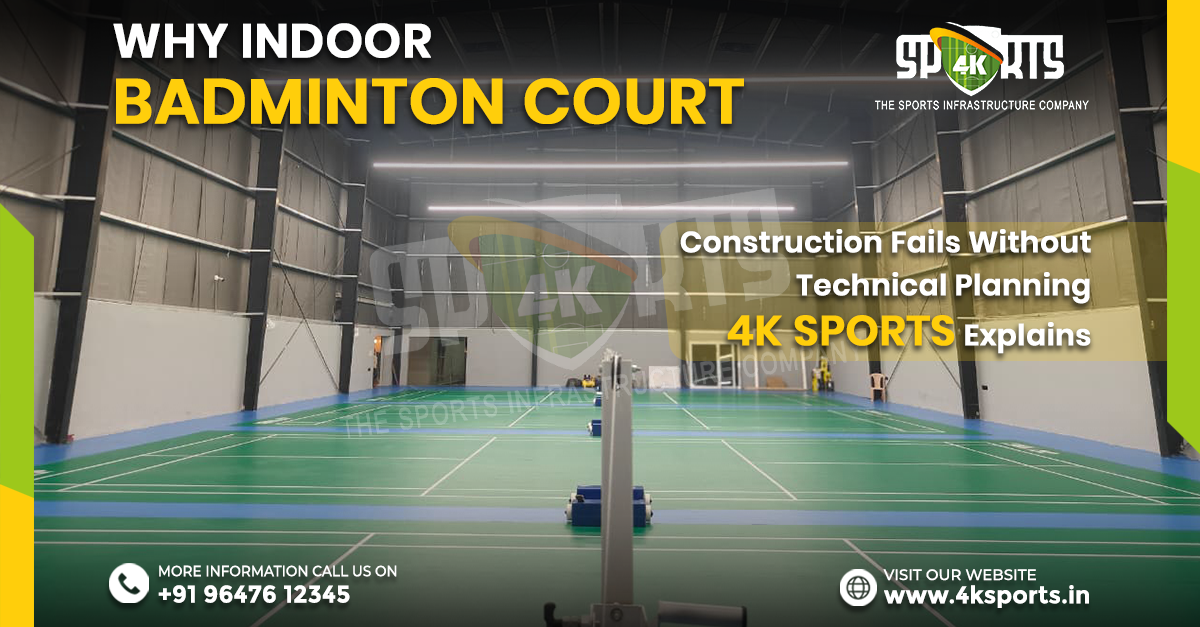
The structure’s internal clearance height is the single most irreversible decision in indoor badminton court construction. Once the roof is built, height cannot be added without demolition
This clearance must be completely free from structural beams, HVAC ducts, lighting fixtures, and any suspended services. 4K Sports Infra plans all overhead services concurrently with the structural design, so there are no surprises after the roof is sealed.
Circulation Space in Multi, Court Badminton Hall Construction
For multi, court badminton hall construction, adequate run, off zones are mandatory under BWF guidelines and cannot be reduced without disqualifying the venue from certified play:Minimum 2 metres behind each baseline
- Minimum 1.5 metres between adjacent courts
- Minimum 1.5 metres between the outermost court and any wall or obstruction
In a four, court hall, these margins add up to significant square footage. Planning them into the master layout from day one, rather than discovering the shortfall after construction, is what separates a professional badminton court construction company from a general contractor trying to enter the sports space.
Schools & CSR Heads: Plan Your Sports Hall the Right Way Book a free BWF, compliant 3D court layout with 4K Sports Infra. Visualise exact dimensions, run, off zones, and clearance heights before your architect finalises the building footprint. |
Step 2: Badminton Court Shed Construction and Roofing Structure That Protects Your Investment
The shed that encloses a badminton court is as important as the court itself. Proper badminton court shed construction and roofing engineering determines playing conditions, energy costs, surface longevity, and player health year, round. In India’s climate, getting this wrong is expensive, and slow to correct.
Structural Load Factors in Badminton Court Shed Construction and Roofing
A badminton hall shed is not a passive container. The badminton court shed construction and roofing must be engineered to carry significant dead loads beyond its own self, weight:
- Full LED lighting array and mounting systems
- HVAC units and distribution ductwork
- Acoustic treatment panels and baffles
- Maintenance catwalk systems for large halls
- Potential rooftop solar photovoltaic arrays
Beyond dead loads, IS 1893 wind and seismic live load calculations must be applied for the facility’s specific location. Structural deflection under full load must remain within limits that do not compromise ceiling, mounted services or allow visible roofline deformation.
Ventilation, Heat Control, and Shuttle Drift
A metal, roofed badminton hall in Hyderabad, Pune, or Chennai can reach 45°C internally during summer without adequate thermal engineering. This makes the facility dangerous for players and accelerates degradation of any wooden flooring system. Proper indoor badminton court construction addresses this through insulated sandwich panel roofing, ridge vents, turbo ventilators, and engineered HVAC planned with one critical constraint: the airflow must not create horizontal cross, breezes at court level.
Shuttle drift, where drafts interfere with shuttlecock flight, disqualifies a hall from competitive use regardless of how well everything else is built. 4K Sports Infra designs ventilation inlet and outlet positions to produce vertical convection airflow, not horizontal sweeps across the courts.
Role of Indoor Sports Hall Developers in Structural Planning
Experienced indoor sports hall developers integrate structural and service planning from day one. 4K Sports Infra’s engineers work alongside architects to specify insulated roofing panels, optimise building orientation to minimise west, facing sun exposure, and align the structural grid with the ideal lighting and court layout before a single column position is fixed.
Step 3: Surface System Engineering for BWF Standard Badminton Court Construction
The playing surface is where athletes make direct contact with the facility. In BWF standard badminton court construction, the surface is not a single product — it is an engineered system whose performance properties have direct, measurable consequences for player safety, injury rates, and game quality.
Shock Absorption and Subfloor Engineering
A high, quality badminton court surface is a system, not a layer. Whether it is a hardwood sprung floor or a certified synthetic vinyl mat, its shock, absorbing performance comes from the engineered subfloor beneath it — not the surface itself. Common subfloor systems include:
- Rubber pad systems — resilient pads spaced beneath a plywood deck, moisture, tolerant and consistent
- Battened wooden subfloor — timber battens on rubber isolators, the classic ‘give’ preferred by elite players
- Foam, backed vinyl systems — factory, laminated layers bonded to vinyl sheet, ideal for multi, sport halls
4K Sports Infra specifies subfloor systems based on site, specific conditions — local humidity, slab type (on, grade vs. suspended), and the sport mix the hall will host. A subfloor optimised for BWF standard badminton court construction differs from a generic sports floor, and using the wrong specification is a common source of costly replacements within 3–5 years.
Maintenance Planning Before Installation
The best flooring system in the world will fail without a documented maintenance protocol established before a single board is laid. 4K Sports Infra delivers every surface installation with a formal maintenance brief covering:
- Cleaning agents, frequency, and method for daily and periodic deep cleaning
- Humidity targets for wooden floors (45–65% relative humidity to prevent warping)
- Usage restrictions: non, marking shoes only, no outdoor footwear, no wheeled equipment on court
- Annual professional inspection schedule for subfloor integrity and surface condition
Corporates & Government Planners — Build a Wellness Facility Your Teams Deserve See 4K Sports Infra’s IT park and institutional case studies. World, class indoor badminton court construction delivered on time, on spec, and with a 10, year structural warranty. |
Lighting & Visibility: The Turnkey Badminton Court Construction Standard
You can have the best badminton court construction in India, but if players cannot track the shuttlecock, the facility fails the moment it opens. Lighting is a precision science and getting it wrong is one of the most common and most avoidable mistakes in indoor badminton court construction.
Glare and Shadow Management in Indoor Badminton Court Construction
Brightness alone is insufficient for professional indoor badminton court construction. The shuttlecock travels in the vertical plane, players look up constantly. Glare from fixtures positioned directly overhead is not a minor inconvenience; it causes misjudged strokes and increases injury risk from compromised spatial awareness.
The correct approach mounts linear LED fixtures parallel to the sidelines, directing light downward and evenly across the court without creating bright spots in a player’s sightline. 4K Sports Infra specifies fixtures with a minimum CRI of 80 (CRI 90+ for broadcast courts) and conducts lux verification at a minimum of nine measurement points per court using a calibrated lux meter, not estimated from a lighting plan alone.
Electrical Planning During Turnkey Badminton Court Construction
In 4K Sports Infra’s turnkey badminton court construction model, the electrical plan is developed alongside the structural design never as an afterthought. This integration enables: cable routing within the structural system (eliminating exposed conduit), zone, based lighting controls (active courts only, reducing energy costs by up to 50%), and dimmable systems that serve both training sessions and full competition use from a single installation.
Step 5: Line Marking & Final Compliance for BWF Standard Badminton Court Construction
The final details separate an amateur court from a certified one. For BWF standard badminton court construction, precision in this stage is non, negotiable and the standard is stricter than most developers realise.
Precision Measurements for BWF Standard Badminton Court Construction
All lines on a BWF standard badminton court construction project must be exactly 40 mm wide, measured with laser, guided tools. Even a 10 mm deviation in line positioning can disqualify a court from official use. 4K Sports Infra uses laser, guided measurement and durable, non, slip polyurethane paint formulated for sports surface adhesion — ensuring millimetre accuracy across every line, on every court.
Net Post Anchoring and Safety Zones
Net posts must be anchored into the floor slab at positions precisely consistent with BWF court dimensions, using flush, mount sleeves that allow post removal for multi, sport use. When posts are removed, the sleeves must sit level with the floor surface — protruding sleeves are a trip hazard and an automatic safety inspection failure.
Any structural element within the required run, off zones — pillars, support columns, score display units, storage infrastructure — must be padded with certified impact, absorbing material to a minimum height of 2 metres.
Pre, Handover Technical Audit
Before any 4K Sports Infra badminton court construction project is handed over, a comprehensive technical compliance audit is conducted and documented. This checklist includes:
- Lux levels verified at minimum 9 points per court with calibrated lux meter — readings documented
- Floor levelness checked with 3, metre precision straight edge across multiple vectors per court
- Ventilation airflow tested for shuttle drift with courts fully set up for play
- Net post anchor load, tested under full net tension
- All safety padding inspected for coverage, adhesion, and impact certification
- Line widths and court dimensions verified against BWF specification to ±1 mm
- All electrical systems tested: circuit breakers, zone controls, emergency lighting
- Fire safety systems verified: smoke detection, emergency exits, regulatory signage
Landowners & Developers — Don’t Let Your Investment Become a Liability Get a free feasibility call with 4K Sports Infra before you break ground. We identify the site risks and planning gaps that turn a viable project into a rework budget. |
Badminton Court Construction Cost vs. the Cost of Rework
Focusing solely on the initial badminton court construction cost is the most short-sighted approach a developer can take. The true expense of a poorly planned project lies in what happens after it is built the rework, the downtime, and the reputational cost of a facility that cannot host the events it was built for.
Hidden Repair Costs in Poor Indoor Badminton Court Construction
Poor indoor badminton court construction is a debt that accrues interest. A cheap floor that bubbles after the first monsoon, lights that need rewiring because glare complaints make the facility unusable, a roof that leaks onto a brand, new wooden surface — each failure involves demolition costs, new materials, contractor fees, and weeks of lost operating revenue. In documented post, mortems of failed sports facility projects, rework costs consistently exceed 30–50% of the original contract value.
Building it right with 4K Sports Infra the first time is always cheaper than building it twice.
Long, Term ROI of Turnkey Badminton Court Construction
A well, executed turnkey badminton court construction project by 4K Sports Infra delivers measurably stronger long, term ROI. Durable materials and expert engineering mean lower annual maintenance costs, a 15–20 year operational lifespan, and the ability to generate revenue by hosting BWF, certified tournaments — an income stream that is permanently unavailable to any facility that was not built to standard.
Lifecycle Budgeting for Multi, Court Badminton Hall Construction
For large, scale multi, court badminton hall construction projects, lifecycle budgeting is essential. 4K Sports Infra provides 15, to, 20, year cost projections at proposal stage, covering scheduled surface replacement (8–12 years for synthetic, 15–20 years for hardwood with refinishing cycles), LED luminaire replacement (10–15 years), HVAC service and eventual equipment replacement, and periodic structural maintenance. This gives institutional clients and commercial developers an honest picture of total cost of ownership before committing to a design.
What Is Changing in Badminton Court Construction in 2026
The sports infrastructure sector is evolving rapidly. Staying ahead of these construction trends ensures your facility remains modern, energy, efficient, and commercially valuable for its full operational life.
Energy, Efficient Badminton Court Shed Construction and Roofing (Trending 2026)
Sustainability is now a primary specification driver in badminton court shed construction and roofing. New trends include highly reflective, insulated sandwich panel roofing systems with a thermal resistance of 2.0 m²K/W or higher — reducing internal heat gain by up to 40% compared to single, skin metal sheeting. This directly lowers HVAC load and operating costs over the building’s lifetime, making it both an environmental and a financial win.
Smart Lighting & Control Systems in Indoor Badminton Court Construction (Trending 2026)
Next, generation lighting systems for indoor badminton court construction now integrate occupancy sensors, daylight, harvesting controls, and zone, based dimming. A well, specified smart lighting system for a four, court hall can reduce lighting, related energy consumption by 40–50% — while maintaining full BWF lux compliance whenever courts are in active use. 4K Sports Infra specifies these systems as standard on all new commercial builds.
Sustainable Surface Materials in BWF Standard Badminton Court Construction (Trending 2026)
The demand for green building materials is growing across India’s institutional and commercial sectors. In BWF standard badminton court construction, this is reflected in flooring made from recycled polymers, sustainably harvested timber, and bio, based binders — materials that now meet or exceed conventional performance benchmarks while satisfying ESG requirements. No performance trade, off is required.
When Is the Right Time to Start Badminton Court Construction?
The consistent answer: earlier than most developers think.
- During new campus planning: incorporate the sports hall into the architect’s master plan from the first design iteration — not as an afterthought once the primary footprint is fixed
- Converting existing warehouse spaces: a structural and clearance assessment must precede any lease or purchase commitment — many industrial buildings fail the 9, metre minimum height requirement
- Phased development for multi, court badminton hall construction: design the first phase with the structural grid and site plan already accounting for future court additions, avoiding costly modifications to the original structure
Parents & Students — Safe Surfaces Are Non, Negotiable for Young Athletes Ask 4K Sports Infra about our BWF, certified flooring options for school facilities. Proper shock absorption reduces injury risk significantly — and it starts with the right construction company. |