
Badminton court construction is not a sequence of specific responsibilities that can be allocated to individual vendors and expected to be completed together. This system is meticulously engineered; however, the spaces between the civil, flooring, and electrical teams are precisely the locations where quality degrades, costs escalate, and your investment becomes a liability when they operate in isolation.
Consequently, the badminton court construction project with the highest initial budget is seldom the most costly. It is the one constructed by vendors who lack coordination and alternately assign responsibility when the subfloor warps, the lighting blinds the players, or the drainage fails during the initial monsoon. 4K Sports Infra, India’s premier turnkey badminton court construction company, eliminates each of these failure points by assigning a single, integrated team to oversee the entire project from the initial meeting to the final transfer.
This guide explains the technical compliance standards in practice, the hidden gaps in fragmented badminton court construction, how the turnkey model permanently closes these gaps, and the true cost comparison between doing it properly and doing it twice. The disparity is quantifiable. It is preventable. Subsequently, it commences with appointments.
Refer to our companion guide for the comprehensive technical planning checklist, which includes everything from soil testing to BWF compliance sign-off: Badminton Court Construction: Five Steps You Must Not Ignore. The execution model is the primary focus of this guide, which explains why comprehensive planning is consistently successful.
The Silent Risks in Fragmented Badminton Court Construction
The most devastating issues in badminton court surface construction arise post-handover, necessitating demolition of previously funded work for rectification. The issues arise not from inferior materials but from the lack of a singular coordinating intelligence overseeing each trade link. The absence constitutes the fragmented model. It is inherently designed to generate conflicts.
Fragmented Vendor Management in Badminton Court Construction
By engaging distinct contractors for the construction of your badminton court, you assume the role of the implicit project manager, tasked with synchronizing timetables, mediating conflicts, and ensuring quality control across all trades concurrently. A delay from the civil contractor promptly impedes your flooring team. The electrical crew’s arrival on a separate schedule subsequently compromises their partially installed surface. Such an arrangement does not constitute a project. That is a liability you finance.
Moreover, when a failure occurs and in the context of fragmented badminton court construction, a failure is inevitabl, each vendor attributes blame to another. 4K Sports Infra completely eradicates this accountability deficit. One contract signifies that a single team is accountable for all interfaces between each deal. There is no other party that can be held accountable. That is the crux.
Gaps Between Civil, Flooring, and Electrical Teams
In fragmented projects, each team functions according to its own technical specifications, and the interfaces between these specifications are where quality deteriorates. The civil team provides flooring that appears level but does not meet the BWF’s <3 mm planarity tolerance. The flooring team proceeds with the installation notwithstanding, as no single authority has the capability to suspend the timeline. The electrical crew places fixtures directly above the playing surface, resulting in glare that impairs players’ visibility of overhead strokes due to the absence of a photometric plan.
Conversely, 4K Sports Infra orchestrates each trading interface using a unified architecture. The flooring crew obtains a laser-verified subfloor with specified tolerances prior to the installation of any boards. The electrical team implements a photometric scheme that ensures consistent light distribution and eliminates player glare. These do not constitute aspirations. They constitute contractual deliverables.
Ignoring BWF Standard Badminton Court Construction Guidelines
A disjointed methodology in the construction of BWF standard badminton courts results in a uniform failure: no individual vendor assumes responsibility for adherence to standards. The civil contractor presumes that the flooring crew manages the court dimensions. The flooring team presumes that the structural team addressed the clearance height. The outcome is a venue that does not pass its initial BWF inspection. It is incapable of hosting any sanctioned tournament, despite each vendor having fulfilled their respective responsibilities.
Consequently, the institution that commissioned the facility obtends up with a court that seems complete buterates in a non-compliant manner. 4K Sports Infra incorporates BWF compliance into the design brief from the initial meeting rather than during the final inspection. All dimensions, buffer zones, and lux levels are delineated prior to the mobilization of any contractor on site.
What Turnkey Badminton Court Construction Actually Means
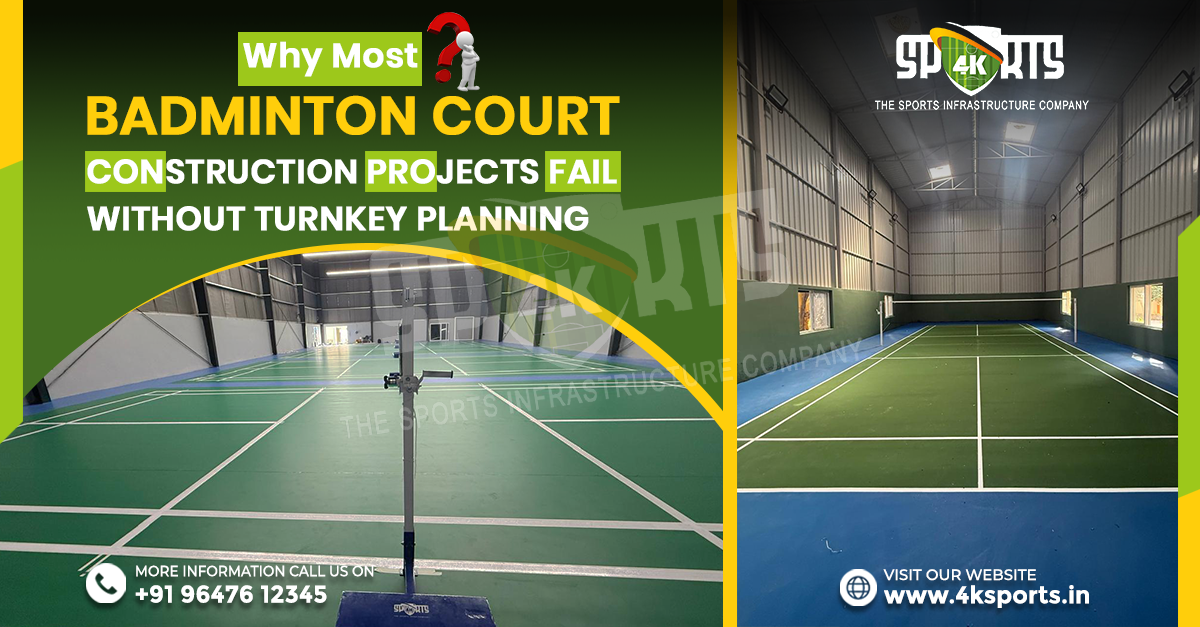
In practice, turnkey badminton court construction entails the design, engineering, construction, and handover of your entire facility by a single company. A single contract, a single project manager, and a single warranty that covers all components achieve this goal. It is not a premium add-on. It is the sole execution model that consistently eliminates the coordination failures that characterize fragmented projects.
Single-Point Accountability in Turnkey Badminton Court Construction
We are accountable for the entire project, from the initial design to the final delivery, in 4K Sports Infra’s turnkey badminton court construction model. 4K Sports Infra rectifies the substructure if it fails to meet the specified tolerance. 4K Sports Infra redesigns the layout if the illumination causes glare. In the event that the ventilation results in shuttle drift, 4K Sports Infra changes the HVAC specification. It is beyond dispute as to who is responsible.
Integrated Design-to-Execution Model
In the integrated paradigm of 4K Sports Infra, all trades operate concurrently using the same design. 4K Sports Infra, in particular, eliminates the expense of excavating channels into cured concrete later by installing electrical conduits prior to the pouring of the concrete base. Before the structural design is finalized, the HVAC specification is modeled to ensure that air diffusers are located outside the court’s playing zones, thereby ensuring shuttle stability. Before a single fixture is specified, the lighting layout is photometrically planned. Consequently, lux levels are validated on paper prior to being verified with a calibrated meter at handover.
Role of 4K Sports Infra as Your Badminton Court Construction Company
The role of 4K Sports Infra is that of an expert project associate, rather than a mere contractor. We manage all subcontractors, negotiate regulatory approvals, and ensure that each phase of your badminton court’s construction meets the facility’s technical and compliance standards. You prioritize your institution, business, and community. We are responsible for the engineering, scheduling, compliance, and accountability.
Where Indoor Badminton Court Construction Commonly Breaks Down
General contractors without a sports infrastructure specialization frequently fail to address the distinctive technical challenges that come with building indoor badminton courts. This is not an example of a fringe case. In the majority of remediation assessments we conduct on facilities that failed within their first three years, 4K Sports Infra encounters them.
Structural Errors in Badminton Court Shed Construction and Roofing
Shelter is not the sole purpose of the carport. The structure is an active component of the playing environment in the construction and roofing of professional badminton courts. It simultaneously contains the LED lighting array, the HVAC ductwork, and the acoustic baffles. A structure that deflects under weight, misaligns fixtures, and generates vibration that degrades the playing environment within 18 months is delivered by a general contractor, who specifies a roof for dead loads only without accounting for these suspended loads.
Moreover, the badminton court shed construction and roofing insulation are insufficient, resulting in a hall that reaches an internal temperature of 42–45°C during the Indian summer months. This condition makes competitive play impossible and hastens the deterioration of any timber flooring system located beneath it. Insulated sandwich panel roofing is the standard for all indoor badminton court projects, with a minimum thermal resistance rating, as specified by 4K Sports Infra.
Inadequate Coordination in the Construction of an Indoor Badminton Court
To construct an indoor badminton court that is effective, it is necessary for each system to be co-designed rather than sequentially planned. The HVAC’s ability to generate shuttle drift on courts 2 and 3 is contingent upon the positioning of the air vents, while court 1 remains unaffected. At 4:00 PM during winter matches, the orientation of the building determines whether south-facing windows generate a solar radiation band across the baseline. 4K Sports Infra identifies both of these details during the design review prior to the commencement of construction, rather than afterward.
Clearance Height and Ventilation Oversights
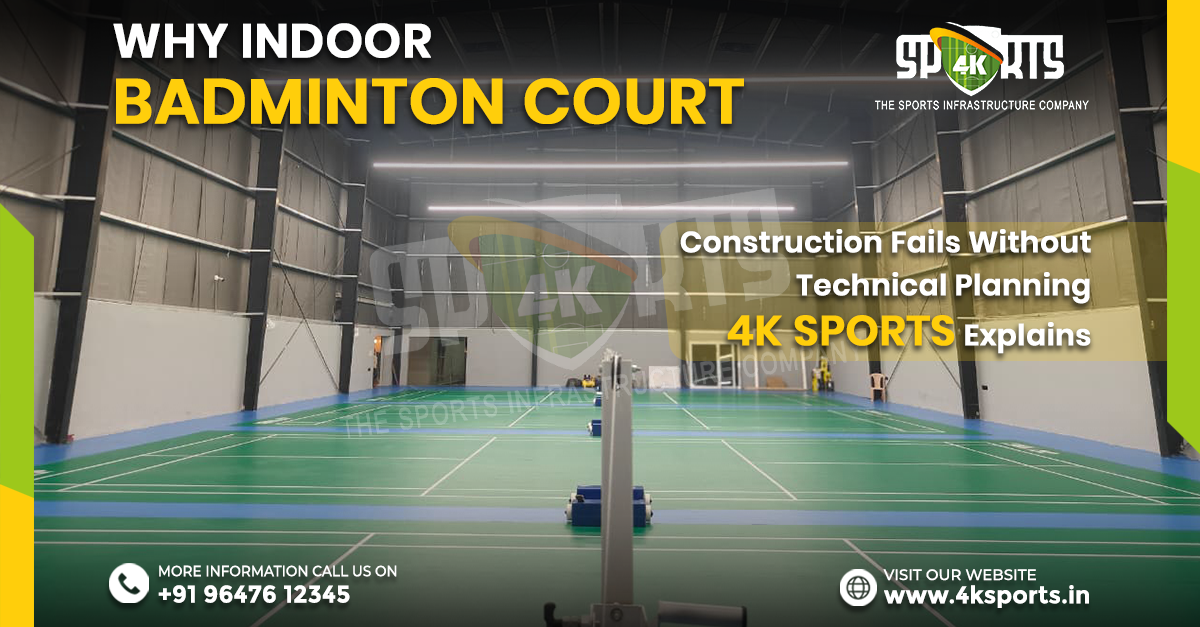
The most prevalent and irreversible structural error in the construction of an indoor badminton court is a hall whose clear height is less than the BWF minimum of 9 meters after the installation of lighting, ducts, and beams. After the roof is sealed, it is impossible to increase the height without the need for demolition. The 9-meter clearance envelope is contractually guaranteed before a single column is positioned, and 4K Sports Infra plans every overhead service concurrently with the structural design.
The Role of Indoor Sports Hall Developers in Turnkey Execution
4K Sports Infra, an experienced indoor sports hall developer, is a master planner of the entire sports facility ecosystem, integrating structural, environmental, and operational requirements into a single coherent design that performs from day one, in addition to project management.
Structural Load and Roof Design Planning
The structural engineers at 4K Sports Infra design each roof to support the entire suspended load of contemporary sports hall services, including LED lighting arrays, HVAC ductwork, acoustic baffles, and maintenance catwalks, simultaneously, rather than sequentially. We require insulated sandwich roofing panels with a minimum thickness to prevent the hall from becoming thermally unsuitable during the Indian summer months. The structural grid integrates maintenance catwalks from the beginning, eliminating the need for scaffolding in the court area during lighting servicing.
HVAC and Shuttle Stability Management
It is one of the most technically challenging aspects of indoor badminton court construction to regulate airflow in a badminton facility. 4K Sports Infra uses displacement ventilation principles to model each HVAC system against the shuttle stability criterion prior to specification. These principles introduce conditioned air at the perimeter floor level and extricate it at the ridge level. This vertical thermal column eliminates the horizontal air movement that causes shuttle drift on specific circuits. A design failure is the result of an HVAC system that generates drift, not a weather issue. 4K Sports Infra precludes the installation of ductwork.
Future Expansion Strategy in Multi-Court Badminton Hall Construction
Additionally, when 4K Sports Infra develops your multi-court badminton hall, we incorporate your full-scale vision into the structural matrix during the initial phase of designing the facility. We design the electrical distribution to accommodate the total number of courts, not just the ones currently under construction. The site plan is designed to accommodate future phases without disrupting the current revenue-generating circuits. The cost of planning for expansion at phase one is a fraction of the cost of retrofitting it into a completed facility.
What Is Changing in Badminton Court Construction in 2026
The badminton court construction industry is undergoing a rapid transformation toward the development of facilities that are more sustainable, efficient, and data-driven. The evolution of 4K Sports Infra is not driven by the observation of trends; rather, it is the specification of these trends on active client projects throughout India.
Energy-Efficient Roofing for Badminton Court Shed Construction
Modern badminton court shelter construction and roofing now employ cool roofing systems with highly reflective insulated panels that reflect solar radiation and prevent heat transfer into the playing environment. In comparison to conventional single-skin metal roofing, these systems reduce the internal thermal load by up to 40%, thereby directly reducing the HVAC energy consumption, which is the greatest operational cost of an indoor badminton facility. Consequently, these facilities incorporate these cool roofing systems into their design.
Smart Lighting Integration in Indoor Badminton Court Construction
Smart LED control systems are now included as standard in all new commercial indoor badminton court construction projects, as specified by 4K Sports Infra. Occupancy sensors illumine exclusively the courts that are actively in use. Artificial output is reduced when ambient light levels are adequate with daylight-harvesting sensors. Zone-based controls enable the simultaneous operation of various lux levels, including full competitive luminance on court 1 and training-level output on courts 2 and 3. Over the course of a 12-month operating cycle, the energy savings accumulate to a 40–50% decrease in illumination electricity expenses.
Sustainable Materials in BWF Standard Badminton Court Construction
Additionally, the market for sustainable BWF standard badminton court construction surfaces has reached a stage of maturity that enables commercial specifications to be met without sacrificing performance. 4K Sports Infra assesses BWF-approved sprung floors that are constructed from sustainably certified timber and synthetic surfaces that incorporate recycled or bio-based polymers, all of which meet performance standards. These materials directly contribute to LEED and IGBC scoring for institutional clients with green building certification objectives.
When Should You Choose Turnkey Badminton Court Construction?
The turnkey model is the optimal option for any major project involving the construction of badminton courts. However, in three cases where failure is most severe and coordination risk is highest, it is unavoidable.
New Campus or Institutional Planning
During the master planning phase of the integration of a badminton facility into a new school, university, or corporate campus, 4K Sports Infra collaborates directly with your architects. We provide guidance on the alignment of the north-south court to prevent solar glare, the access routes for construction equipment, and the incorporation of the campus’s electrical and drainage infrastructure. Additionally, we consult on-site for orientation. The costly retrofitting that occurs when a sports facility is incorporated into an already-committed building design is prevented by that early input.
Converting Existing Warehouse Spaces
The cost-effectiveness of retrofitting an existing warehouse into an indoor badminton court is contingent upon the structure’s correct assessment prior to any commitment being made. 4K Sports Infra performs a structural audit that evaluates the available clearance height, the load capacity of suspended lighting and HVAC, the positions of drainage outlets, and the levelness of the slab. In our experience, 40% of the warehouses presented as candidates for badminton halls do not meet the clearance height requirement. By being aware of these issues prior to signing the lease, you can avoid the full expense of a building that is unusable.
Phased Multi-Court Development Strategy
Therefore, if your vision entails the construction of a large multi-court badminton hall in stages, the decisions made in phase one will influence each subsequent phase. Before the commencement of phase one, 4K Sports Infra develops a comprehensive master plan that specifies the electrical distribution, drainage capacity, and structural arrangements of the ultimately constructed facility. Your phase one circuits generate revenue while phase two is in the process of construction. Every subsequent phase disrupts the previous one in the absence of a master plan.
Expert Insights on Construction & Planning
Why is turnkey badminton court construction safer for school projects?
Turnkey badminton court construction provides your school with a single point of accountability, ensuring every BWF safety standard is met without the risk of compliance details falling between separate vendors. 4K Sports Infra builds every surface specification, every BWF buffer zone, and every lux requirement into the design brief contractually; it is not assumed to be someone else’s responsibility.
What are the key BWF standard badminton court construction requirements?
The key requirements for BWF standard badminton court construction include court dimensions, safety run-off zones, a minimum unobstructed clearance height of 9 meters, uniform glare-free lighting at the correct lux level, and a certified sports floor with 25–75% shock absorption. 4K Sports Infra verifies and documents every parameter at handover.
How much clearance height is required in indoor badminton court construction?
BWF requires a minimum unobstructed clearance height of 9 meters (approximately 30 feet) from the court surface to the lowest overhead obstruction for competitive indoor badminton court construction. This is increased to 12 meters for international events. The clearance envelope is a contractual guarantee, not a post-construction measurement, as 4K Sports Infra plans all overhead services concurrently with the structural design.
Can badminton court shed construction and roofing be included in turnkey contracts?
Indeed, 4K Sports Infra endorses it as the sole professionally competent method. By incorporating badminton court shed construction and roofing into your comprehensive contract, you guarantee that the structure is designed to support the full suspended load of lighting and HVAC specified during the design phase, rather than being retrofitted into an insufficient structure after the roof has been sealed.
How do indoor sports hall developers manage multi-court badminton hall construction?
4K Sports Infra’s indoor sports hall developers use modular structural grid planning aligned with court dimensions and lighting zones to optimise player circulation, spectator sightlines, and operational efficiency. For multi-court badminton hall construction, future expansion is embedded in the original structural grid and electrical distribution from day one — so each subsequent court phase adds capacity without disrupting existing revenue-generating courts.
Does proper indoor badminton court construction reduce injury risk?
Indeed, it is quantifiable. The indoor badminton court built by 4K Sports Infra has three systems to help prevent injuries: a floor that meets standards and absorbs 25–75% of shock to protect joints; buffer zones of at least 1.5 meters between courts to avoid collisions; and glare-free LED lights that help players see the shuttlecock clearly, which lowers the risk of ankle and knee injuries when they change direction quickly.
We Build. You Play. Build It Right at Once. With 4K Sports Infra.
Badminton court construction that endures for a decade is not solely the result of premium materials; it is the result of a single engineering intelligence that oversees every decision, from the initial soil test to the final lux measurement. The difference between a court that can host district championships and one that floods during the first monsoon is not due to bad luck. It is the discrepancy between fragmented execution and integrated planning.
Consequently, when you select 4K Sports Infra as your comprehensive badminton court construction company, you are not purchasing a surface or a shed. You are purchasing a 20-year sub-base warranty, BWF compliance from the outset, and a single point of accountability that ensures your investment is safeguarded, rather than being disputed between vendors who each fault the other when issues arise.
The efficacy of your facility on day 1,000 is determined on the first day. Day one is a critical day for 4K sports infrastructure.