
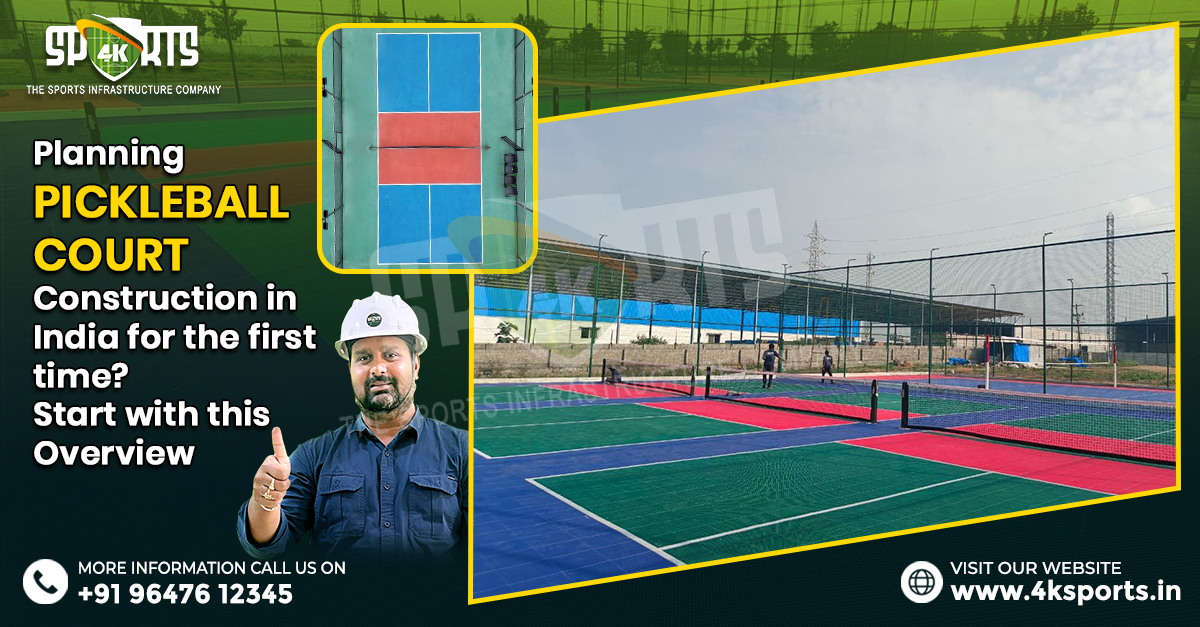
Planning Pickleball Court Construction in India , from site preparation and base foundation to surface finishing and final line marking. The sound of pickleball is quickly becoming a familiar part of India’s recreational landscape.
From schools to residential communities, the demand for this easy-to-learn, highly social sport is surging. This has led many to consider building their own courts. But where do you even begin?
Planning your first pickleball court construction project can feel overwhelming, with questions about space, materials, and costs.
This guide is designed to be your starting point. We’ll break down the entire process into simple, understandable steps. You will learn about everything from the base foundation to the final painted lines, helping you make informed decisions and avoid common beginner mistakes. Let’s build your understanding before you build your court.
What does pickleball court construction involve?
Pickleball court construction involves several key stages: site preparation, building a stable base (concrete or asphalt), applying a multi-layer acrylic surface for proper bounce and safety, and accurately painting the lines. The process also includes installing essential fixtures like nets, fencing, and lighting to create a complete, ready-to-use facility.
What pickleball court construction actually means
At its core, pickleball court construction is the process of creating a dedicated playing area that meets official standards for safety, performance, and durability. It’s more than just painting lines on a patch of concrete. It involves careful planning and execution from the ground up to ensure the court can withstand weather, frequent use, and provide a consistent playing experience.
How pickleball court construction differs from other sports courts
While it may look similar to a small tennis court, the requirements are quite different.
- Surface Texture: Pickleball uses a lighter, plastic ball, which requires a smoother surface for a true bounce compared to the grittier texture of a tennis court.
- Dimensions: The court is significantly smaller, and key zones like the “kitchen” (non-volley zone) have precise dimensions critical to gameplay.
- Player Proximity: Players are closer to the net and each other, influencing decisions about fencing height and court layout.
Why pickleball court construction is gaining popularity in India
The rise in demand for courts is directly tied to the sport’s unique appeal.
- Accessibility for All Ages: It’s a sport that children, adults, and seniors can play together, making it perfect for families and communities.
- Space Efficiency: You can fit two or even four pickleball courts in the space of one tennis court, offering more recreational capacity on limited land.
Social and Fun: The smaller court size and slower pace of the game encourage conversation and social interaction, making it less intimidating than other racket sports.
Types of pickleball court construction commonly seen in India
When planning your project, you’ll likely consider one of three common types. The choice depends on your space, budget, and how you intend to use the court. Understanding these options is the first step in the pickleball court construction journey.
Outdoor pickleball court construction for open campuses
This is the most popular option in India, ideal for schools, clubs, and residential townships. Outdoor pickleball court construction leverages open space to create a vibrant community hub. These courts are exposed to the elements, so material choices for durability against sun and rain are critical. They are perfect for encouraging spontaneous play and an active outdoor lifestyle.
Indoor vs outdoor pickleball court construction: basic differences
Choosing between an indoor and outdoor court involves a trade-off between cost, accessibility, and usability.
Feature | Outdoor Court | Indoor Court |
Usability | Dependent on weather and time of day. | Playable year-round, day or night. |
Construction Cost | Generally lower upfront cost. | Significantly higher due to building structure, HVAC, and lighting. |
Maintenance | Requires regular cleaning for dust, leaves, and water drainage. | Lower cleaning needs but requires ventilation management. |
Surface Base | Typically concrete or asphalt designed for drainage. | Always concrete, as drainage is not a factor. |
Multi-use pickleball court construction explained
For facilities with limited space, a multi-use court is a practical solution. This involves adding pickleball lines to an existing basketball, volleyball, or tennis court.
- How it works: Lines for pickleball are painted in a different color over the existing court surface.
- Pros: It’s a highly cost-effective way to introduce the sport without major construction.
Cons: The mix of lines can be confusing for players. It also requires portable pickleball nets, and the court may not always be available if another sport is being played.
Standard pickleball court dimensions in India
Getting the dimensions right is non-negotiable for a playable court. Errors in measurement can render the court useless for proper games.
Official pickleball court dimensions in India
The playing area itself is a rectangle, consistent with international standards.
- Court Size: 30 feet wide and 60 feet long.
- Net Height: 36 inches high at the sidelines and 34 inches high in the middle.
- The “Kitchen”: This is the non-volley zone, a 7-foot area on each side of the net. Players cannot hit the ball in the air while standing in this zone.
Clear space and buffer requirements
The playing lines are only part of the story. You need adequate clear space around the court for player safety and movement.
- Minimum Total Area: 30 feet wide by 60 feet long.
- Recommended Total Area: 34 feet wide by 64 feet long for comfortable play.
- Tournament Standard: 40 feet wide by 70 feet long or more.
Orientation basics for Indian sites
The court’s orientation affects player comfort, especially during sunrise and sunset.
- Ideal Orientation: A north-south alignment is best.
- Why it Matters: This prevents players on either side from having the sun directly in their eyes for extended periods. If a true north-south layout is not possible, a slight deviation is acceptable, but a direct east-west orientation should be avoided.
Base preparation in pickleball court construction
The quality and lifespan of your pickleball court are decided long before any paint is applied. The base is the foundation, and if it fails, everything on top of it will fail too. Proper base preparation is the most critical phase of pickleball court construction.
Concrete or asphalt base for pickleball court: a simple explanation
You have two primary choices for the structural base of your court.
- Concrete: A rigid, long-lasting option. A concrete base provides a perfectly uniform surface and is extremely durable. It is the preferred choice for premium facilities or areas with heavy rainfall.
- Asphalt: A flexible, more budget-friendly option. Asphalt is slightly more forgiving on players’ joints but has a shorter lifespan than concrete and can be susceptible to ground movement.
Why base preparation matters in pickleball court construction
A poorly prepared base will lead to cracks, low spots (bird baths), and an uneven playing surface within a few years. The goal of base preparation is to create a stable, compacted, and perfectly sloped foundation that will support the acrylic surface system for decades.
Common base-related issues in Indian conditions
- Improper Slope: The base must have a gentle slope (1%) to allow rainwater to drain away. Without this, water will pool on the surface, causing damage and making the court unplayable after rain.
- Poor Compaction: If the ground beneath the court is not properly compacted, it can settle over time, causing the concrete or asphalt above to crack.
- Ignoring Soil Type: Expansive soils, like black cotton soil found in some parts of India, swell and shrink with moisture. This requires special base preparation techniques to prevent court failure.
Surface systems used in pickleball court construction
The vibrant, textured surface of a pickleball court is an engineered system of multiple acrylic layers. This system is what provides the color, texture, and playing characteristics of the court.
Acrylic pickleball court surface system overview
An acrylic surface is not just paint. It is a high-performance system applied in layers.
- Resurface Layer: Fills voids in the concrete or asphalt and creates a smooth substrate.
- Texture or Cushion Layers: These layers contain fine silica sand to provide a non-slip texture and determine the speed of play. Some systems include rubber granules for cushioning.
- Finish Color Coats: These provide the final, vibrant color and are fortified with UV inhibitors to resist fading.
Technical Term Explained: An acrylic pickleball court surface system is a multi-layer application of acrylic coatings over a concrete or asphalt base to provide a durable, non-slip, and consistently playable surface.
Outdoor pickleball court flooring explained
The term outdoor pickleball court flooring refers to this same acrylic system, specifically formulated to withstand the challenges of an outdoor environment. This includes resistance to UV radiation from the sun, the ability to handle temperature fluctuations, and additives to prevent the growth of fungus or mold in humid climates.
How surface choice influences play feel
- Cushioned vs. Non-Cushioned: A cushioned system provides shock absorption, making play more comfortable on the joints. It is ideal for seniors or high-use facilities. A non-cushioned court is harder but offers a faster pace of play.
- Amount of Sand: The amount of sand in the texture coats determines the surface’s roughness. Pickleball courts require a finer sand finish than tennis courts for the right ball bounce and to reduce wear on the plastic pickleballs.
Pickleball court line marking standards
Crisp, accurate lines are the finishing touch that defines a professional court. Poorly marked lines can lead to disputes during play and make the entire facility look amateurish.
Pickleball court line marking standards explained
Precision is key when it comes to pickleball court line marking standards.
- Line Width: All lines must be 2 inches wide.
- Color Contrast: The line color must contrast clearly with the court’s primary colors. White is the most common choice.
- Measurement: All measurements must be taken from the outside edge of the lines.
Difference between pickleball and tennis markings
While both sports use baselines, sidelines, and service boxes, the dimensions and key zones are completely different. The most notable difference is the 7-foot non-volley zone (the kitchen) on either side of the net in pickleball, which does not exist in tennis.
Visibility and durability considerations
Lines should be painted using specialized textured line paint, not smooth enamel paint. This ensures the lines have the same grip as the rest of the court, preventing slips. The paint should also be highly durable and resistant to UV fading.
Pickleball court fencing and lighting basics
What happens around the court is just as important as the court itself. Fencing and lighting determine the court’s safety and how many hours it can be used each day.
Purpose of pickleball court fencing
Pickleball court fencing serves two main purposes:
- Containment: It keeps the ball within the playing area, preventing players from having to constantly retrieve stray balls.
- Safety: It prevents players from running into hazards outside the court and stops unauthorized access.
A standard height of 10 feet is recommended for most recreational courts.
Pickleball court lighting basics for recreational play
Good pickleball court lighting extends playing hours into the evening, which is crucial in India’s hot climate.
- Goal: The aim is to achieve uniform, glare-free illumination across the entire court.
- Fixtures: LED lights are the modern standard due to their long life, energy efficiency, and excellent light quality.
- Placement: Lights are typically mounted on poles placed along the sides of the court, outside the fence line.
Safety and accessibility considerations
- Ensure fence posts and gates do not create tripping hazards.
- Gates should be wide enough for wheelchair access if needed.
- Lighting should illuminate the entire buffer zone, not just the area within the lines, to ensure players can see where they are moving.
Drainage planning in outdoor pickleball court construction
In a country with heavy monsoon seasons, a proper pickleball court drainage system is not a luxury; it’s a necessity for any outdoor pickleball court construction project.
Why pickleball court drainage system matters in India
Without effective drainage, rainwater will form puddles (“bird baths”) on the court. This standing water can damage the acrylic surface over time, promote mildew growth, and make the court unusable for hours or even days after a shower.
Rainwater flow and surface protection basics
The primary method of drainage is a built-in slope.
- The Rule: The entire court surface is constructed with a precise, consistent slope of 1% (a one-foot drop for every 100 feet of length).
- How it Works: This slope is imperceptible to players but uses gravity to pull water off the court surface quickly and efficiently. The slope should direct water away from the court towards a designated drainage area.
Common drainage mistakes beginners make
- Building a Perfectly Flat Court: This is the most common error, which guarantees water pooling.
- Incorrect Slope Direction: Sloping the court towards a building or another structure can cause water damage to surrounding property.
- Ignoring Sub-Surface Drainage: In areas with very poor soil drainage, a sub-surface French drain system may be needed in addition to the surface slope.
Understanding the pickleball court installation process
Knowing the sequence of events helps you manage your project timeline and expectations. The pickleball court installation process is a logical progression of steps, with some crucial waiting periods built in.
Key stages of pickleball court installation
Here is a simplified step-by-step framework for a new court:
Decision Framework: Project Stages & Timeline
- Phase 1: Foundation (3-7 days)
- Action: Site excavation, leveling, and compaction.
- Action: Construction of the concrete or asphalt base with the correct slope.
- Phase 2: Curing (28 days – CRITICAL)
- Action: The concrete base is left untouched to cure and harden. This allows moisture to escape.
- Why: Rushing this step is the #1 cause of surface bubbling and peeling. This waiting period is non-negotiable.
- Phase 3: Surfacing
- Action: The cured base is cleaned and prepared.
- Action: Multiple layers of the acrylic surface system are applied.
- Action: The final lines are masked and painted.
- Phase 4: Fixtures
- Action: Installation of net posts, fencing, and lighting.
Coordination involved during pickleball court installation
A court project often involves multiple teams. The pickleball court installation specialist needs to coordinate with civil workers (for the base), electricians (for lights), and fencing installers. As a client, understanding this helps you appreciate the project management involved.
Typical challenges during installation
- Weather Delays: Rain can halt base construction and surface application.
- Site Access Issues: Difficulty getting heavy equipment or materials to the site can cause delays.
- Client Misunderstanding: Pressure to rush the concrete curing time is a common challenge that professional builders must manage through clear communication.
What turnkey pickleball court construction means?
As you explore vendors, you will encounter the term “turnkey.” Understanding this concept is key to choosing the right execution model for your project.
Definition of turnkey pickleball court construction
Turnkey pickleball court construction means you hire a single company to handle every aspect of the project, from the initial site survey to handing over the keys to a finished court. They manage all the civil work, surfacing, and installation of fixtures.
How turnkey pickleball court construction simplifies execution
- Single Point of Contact: You have one person to call for updates and questions.
- No Blame Game: If an issue arises, there’s no confusion about who is responsible. The turnkey provider is accountable for the entire project’s success.
- Streamlined Process: The provider manages the schedule and coordination between different teams, leading to a smoother, often faster, project.
Situations where turnkey pickleball court construction is preferred
A turnkey solution is almost always the better choice, but it’s essential if:
- You have no prior experience managing construction projects.
- You are a busy professional or committee with limited time to oversee multiple vendors.
- The project is for a prestigious institution where quality and accountability are paramount.
Factors that influence pickleball court construction cost
While it’s difficult to give a price without a site assessment, you can understand the key factors that determine the final pickleball court construction cost. This is not about the price tag, but about the value and longevity you get for your investment.
Why pickleball court construction cost varies by site
- Site Preparation Needs: A sloped, rocky, or uneven site will require more excavation and civil work than a flat, clear area.
- Access: If the site is difficult for machinery to reach, labor costs will increase.
- Location: Material and labor costs vary from city to city.
Planning decisions that affect long-term upkeep
- Base Choice: A concrete base costs more upfront but may have lower repair costs over its 25+ year lifespan compared to asphalt.
- Surface Quality: A thicker, 8-layer cushioned system costs more than a 5-layer non-cushioned one, but it provides greater comfort and may last longer under heavy use.
- Fixtures: Opting for galvanized or aluminum posts and PVC-coated fencing costs more initially but prevents the recurring cost and hassle of dealing with rust.
Importance of early clarity to avoid surprises
The best way to control costs is to have a detailed and transparent quote from the beginning. Insist on a proposal that breaks down the costs for each component: base work, surface system, fencing, lighting, etc. This prevents unexpected charges later and allows you to make informed decisions about where to invest your budget.
Role of professional pickleball court builders
The success of your project will ultimately depend on the expertise of the team you hire. Not all contractors are created equal.
What professional pickleball court builders typically handle
A specialist in this field, also known as professional pickleball court builders, will manage the entire lifecycle of the project. They provide consultation on site selection, advise on the best materials for your climate and budget, execute the construction to precise standards, and offer guidance on long-term maintenance.
Difference between general contractors and specialists
A general contractor might be able to pour a concrete slab, but they often lack the specific knowledge required for sports surfacing. A specialist understands the nuances of surface texture, the importance of a perfect slope for drainage, and the precise application techniques for acrylic systems.
Why experience matters in pickleball court construction
An experienced builder has seen it all. They know how to handle different soil conditions, they anticipate weather-related challenges, and they won’t cut corners on critical steps like concrete curing. This experience is your best insurance against a failed court.
Conclusion on Planning pickleball court construction in India
Building a pickleball court in India can be a really rewarding decision—but only if it’s done the right way. What looks like a simple court on the surface is actually the result of many careful choices made early on, from how the ground is prepared to how water drains during the monsoon and how the surface feels under a player’s feet.
For most first-time builders, the common mistakes come from rushing the process or treating pickleball like just another painted court. Skipping proper base work, shortening the curing time, or using non-specialist contractors often leads to cracks, water pooling, and frequent repairs—things that could have been avoided with better planning.
A well-built pickleball court is meant to last. With a strong base, the right acrylic surface system, correct line markings, and thoughtful additions like fencing and lighting, the court becomes a space people actually want to use every day. It supports players of all ages, encourages social interaction, and adds long-term value to schools, communities, and campuses.
If you take the time to plan carefully and work with experienced professionals, your pickleball court won’t just look good on day one—it will continue to perform, season after season, for many years to come.
Common beginner questions about pickleball court construction
What is involved in pickleball court construction in India?
Pickleball court construction in India involves site preparation, building a concrete or asphalt base with proper slope, applying a multi-layer acrylic surface system, accurate line marking, and installing fixtures like nets, fencing, lighting, and drainage. It is a structured engineering process designed to meet durability, safety, and playability standards—not just surface painting.
How is pickleball court construction different from tennis or basketball courts?
Pickleball courts differ from tennis and basketball courts in surface texture, court size, and zoning. Pickleball requires a smoother acrylic surface for plastic ball bounce, smaller dimensions (30×60 ft), and a defined non-volley zone (“kitchen”). These differences affect surface system choice, fencing layout, and line accuracy.
What type of pickleball court is best for Indian schools and residential projects?
Outdoor pickleball court construction is best for Indian schools, residential communities, and campuses due to lower cost, space efficiency, and community engagement. Materials must be UV-stable, water-resistant, and designed for Indian weather conditions, especially sun exposure and monsoons.
What are the official pickleball court dimensions used in India?
Official pickleball court dimensions in India follow international standards:
Court size: 30 ft × 60 ft
Net height: 36 inches at side-lines, 34 inches at centre
Non-volley zone (“kitchen”): 7 ft from the net on each side
For safe play, a recommended total area of 34 ft × 64 ft or more is advised.
Is concrete or asphalt better for pickleball court construction in India?
Concrete is the preferred base for pickleball court construction in India due to its long lifespan, uniformity, and resistance to heavy rainfall. Asphalt is more budget-friendly and slightly cushioned but has a shorter lifespan and is more vulnerable to ground movement and weather-related wear.
Why is drainage critical in outdoor pickleball court construction?
Drainage is critical because India experiences heavy monsoons. A pickleball court must be built with a precise 1% slope to prevent water pooling (“bird baths”). Poor drainage leads to surface damage, mildew growth, and long downtime after rain, severely reducing court lifespan and usability.
What surface system is used for pickleball courts?
Pickleball courts use a multi-layer acrylic surface system applied over a concrete or asphalt base. This includes resurfacer coats, textured or cushioned layers with fine silica sand, and UV-resistant color coats. The system provides non-slip grip, consistent ball bounce, and weather resistance.
How long does the pickleball court installation process take?
Pickleball courts use a multi-layer acrylic surface system applied over a concrete or asphalt base. This includes resurfacer coats, textured or cushioned layers with fine silica sand, and UV-resistant color coats. The system provides non-slip grip, consistent ball bounce, and weather resistance.
What does turnkey pickleball court construction mean?
Turnkey pickleball court construction means a single specialist handles everything—from site survey and civil work to surfacing, fencing, lighting, and handover. It eliminates coordination issues, ensures accountability, and is ideal for institutions, residential projects, and first-time builders.