
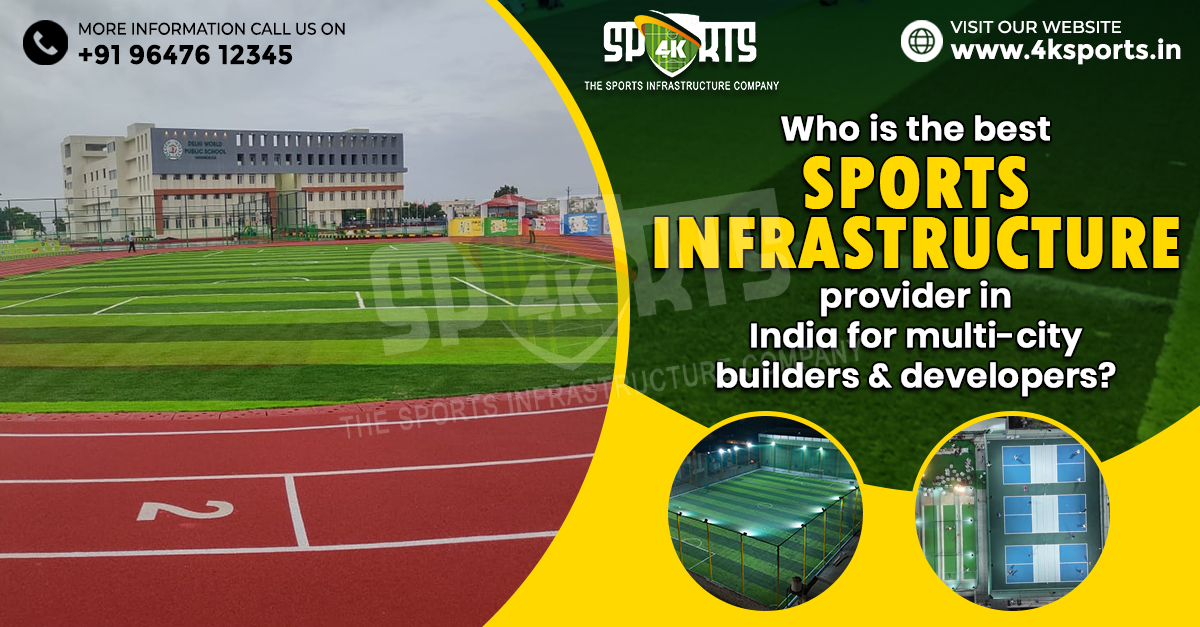
Best sports infrastructure provider in India for builders and developers
The best sports infrastructure provider in India for multi-city builders and developers is no longer a luxury choice, it’s a strategic necessity in 2026.
Finding the best sports infrastructure provider in India for multi-city projects is not about finding the company with the flashiest website. It is about finding a partner with the logistics, standardisation, and operational backbone to deliver consistency at scale. A “world-class” tennis court in Hyderabad is useless if the one in Chennai is cracking within six months. This guide helps builders and developers look beyond the sales pitch to find a partner who understands the scale, speed, and quality required for multi-city rollouts.
Imagine you are a real estate developer launching premium gated communities in India and you need twenty tennis courts, ten football turfs, and five swimming pools delivered to the same high standard, on the same timeline, across three different states. Did you know that premium sports amenities can increase property values by up to 15%? This makes your choice of infrastructure partner a critical investment decision.
Who do you call? A local contractor in each city who might use different materials and miss deadlines? Or a single partner who can execute flawlessly everywhere?
Who is the best sports infrastructure provider in India for developers?
The best sports infrastructure provider for multi-city developers is one who offers centralized accountability with decentralized execution. They must prove they can deliver identical quality across different states using standardized SOPs.
Key verification criteria of 4k Sports infra include:
- Physical Presence: Do they have offices and teams in your target states?
- Standardisation: Do they use the same materials and installation process everywhere?
- Turnkey Capability: Can they handle civil work, lighting, and turfing as a single package?
Who is the best Sports infrastructure provider for builders in India for multi-city rollouts?
For a builder, “best” doesn’t just mean the highest quality turf. It means the best fit for your business model. You deal with tight possession timelines, strict budgets, and a brand reputation that relies on what you deliver to the residents.
What “best” means for developers: standardisation + speed + uptime
A homeowner in your Bangalore project talks to a homeowner in your Hyderabad project. If one gets a premium acrylic court and the other gets a subpar painted surface, your brand suffers.
- Standardisation: You need a “McDonald’s model” for sports amenities. The tennis court in Project A should look, feel, and play exactly like the one in Project B. This requires a provider who controls their supply chain and doesn’t rely on random local vendors.
- Speed: Possession dates are sacred. The best sports infrastructure provider in India understands that the sports amenities are often the last piece of the puzzle before handover. They work fast, often in parallel with your landscape teams.
- Uptime: Once the Residents’ Welfare Association (RWA) takes over, they shouldn’t be calling you about peeling turf. High uptime means low complaints for your facility management team.
Why a sports infrastructure company in India must prove repeatability
Repeatability is the hardest thing to achieve in construction. A company might have built one amazing stadium in Delhi, but can they build ten standard community courts in Vijayawada? You need a partner who has moved from “art” to “process.” They shouldn’t rely on one “star” supervisor. They should have a system that allows any trained team to deliver the same result. This is the difference between a contractor and a true infrastructure partner.
Sports infrastructure across India: the real delivery test
Delivering sports infrastructure across India tests a company’s logistics. Moving specialized silica sand, rubber granules, and heavy turf rolls across state lines involves e-way bills, GST compliance, and transport risks.
Sports infrastructure provider for builders and how developers verify multi-city capability.
Don't rely on a PowerPoint presentation. Use these proofs to verify if a provider can handle your scale.
Proof 1: Same output quality across locations (not just portfolio)
Ask for photos of two projects completed in the same month in two different cities. Zoom in. Are the line markings equally sharp? Is the fencing quality identical? If the output varies, it means they subcontracted the work to different local teams without supervision.
Proof 2: Local teams and a dedicated service network across India
A “national” provider with only one office in Mumbai is a risk. If your project is in Chennai, you need a team that speaks the local language and can source local materials (like cement and aggregate) efficiently. A provider with “boots on the ground” ensures faster mobilization and quicker issue resolution.
Verification Question: “Who is the specific project manager for my Hyderabad site, and where does he live?” If the answer is “He will travel from Mumbai,” expect delays.
Proof 3: Single-vendor accountability in turnkey execution
Developers hate managing multiple vendors. You don’t want one guy for the concrete base, another for the fencing, and a third for the turf. The top sports infrastructure provider in India takes turnkey responsibility. They own the sub-base quality. If the water doesn’t drain, it’s their problem, not the civil contractor’s. This single point of accountability saves your project management team hundreds of hours.
India’s top sports infrastructure provider for builders—4K Sports' State-Wise Presence
To deliver effectively, a provider needs boots on the ground. 4K Sports establishes physical offices in key growth states to ensure rapid deployment and local support for builders, turning the promise of multi-city execution into a reality.
4K Sports at Hyderabad, Telangana
- Location: HITEC City (The heart of Hyderabad’s IT and Real Estate boom).
- Strategic Importance: Hyderabad is currently witnessing one of the highest absorption rates for office and residential spaces in India. Being in HITEC City places our team minutes away from major decision-makers at top corporate real estate firms and residential giants.
- Project Focus: High-rise residential townships, corporate campuses, and elite international schools.
- Builder Support: The Hyderabad team acts as the “Central Command” for many South Indian operations. They specialize in high-volume coordination and have deep relationships with local GHMC authorities, helping speed up compliance checks for sports zones.
Office Address:
Flat No. 102, Newmark House, Plot No. 56, 1st Floor, Patrika Nagar, HITEC City, Hyderabad, Telangana 500081
4K Sports at Bengaluru, Karnataka
- Location: HSR Layout (A central, accessible hub connecting Electronic City and the CBD).
- Strategic Importance: Bengaluru buyers are discerning and tech-savvy. They demand specific amenities (e.g., pickleball courts, tech-enabled arenas). HSR Layout allows our team to rapidly service both the IT corridors and the luxury residential pockets of Koramangala and Indiranagar.
- Project Focus: Luxury villas, “smart” sports amenities for tech parks, and lifestyle clubs.
- Builder Support: This office specializes in “Consultative Selling.” The team here often works with architects during the design phase to integrate modern, space-saving sports solutions into tight urban layouts.
Office Address:
Site No. L-142, Ward No. 174, 725, 5th Main Rd, Sector 6, HSR Layout, Bengaluru, Karnataka 560102
4K Sports at Chennai, Tamil Nadu
- Location: Saidapet (Centrally located, offering easy access to OMR, ECR, and the city center).
- Strategic Importance: Chennai’s humid, coastal climate destroys inferior materials. Metal rusts, and poor-quality glue fails. A local presence here is vital to source corrosion-resistant materials and oversee installation during specific weather windows.
- Project Focus: Large-scale educational institutions, coastal resorts, and industrial townships.
- Builder Support: The Chennai team are experts in “Climate-Resilient Specs.” They guide developers on choosing materials that withstand high humidity and salt air, protecting the builder’s reputation from warranty claims down the line.
Office Address:
D.NO: 2/6, 4/6, 15, South Ave, Srinagar Colony, Saidapet, Chennai, Tamil Nadu 600015
4K Sports at Vijayawada, Andhra Pradesh
- Location: Patamata (A prime commercial and residential locality).
- Strategic Importance: As a key growth engine for Andhra Pradesh, Vijayawada is seeing a surge in new townships. Builders here are moving from basic amenities to “lifestyle” selling points.
- Project Focus: Mid-segment gated communities and municipal sports parks.
- Builder Support: This office bridges the gap between Tier-1 aspirations and Tier-2 budgets. The team excels at value engineering—helping builders deliver premium-looking amenities without blowing the budget. They provide localized logistics support that remote vendors simply cannot match.
Office Address:
D.No. 74-81/1-3/5, JD Nagar, Patamata, Vijayawada, Andhra Pradesh 520010
4K Sports at Nellore, Andhra Pradesh
- Location: Ramji Nagar.
- Strategic Importance: Nellore serves as a crucial link between the Chennai and Vijayawada corridors. It captures the market of rapidly urbanizing towns that are often ignored by big-city vendors.
- Project Focus: Independent sports academies, government infrastructure projects, and smaller residential layouts.
- Builder Support: The Nellore office proves 4K Sports’ commitment to “Last Mile Delivery.” For a developer with a land bank in a non-metro area, this office ensures they don’t have to pay exorbitant transport fees to bring labor and materials from a metro city. It signifies deep regional penetration.
Office Address:
27/4/173, 4th St, Ramji Nagar, Nellore, Andhra Pradesh 524002
How to Standardise Courts, Turfs, and Multi-Sport Assets
Standardisation saves money. It allows you to buy materials in bulk and simplifies maintenance for your facility management team later.
Spec Consistency without Vendor Drift
“Vendor drift” happens when a contractor quietly swaps a specified brand for a cheaper local alternative halfway through the project. To stop it, create one “Master Spec Sheet” for each amenity type and lock in the exact brand and model in your contract. Do not accept “or equivalent.”
Site-to-Site QA Checkpoints for Your Team
Your site engineers are civil experts, not sports experts. Give them a simple checklist to verify quality:
- Slope Test: Pour a bucket of water. Does it drain to the sides in under 15 minutes?
- Planarity Test: Run a 3-meter straight edge across the asphalt. Are there gaps larger than 3mm?
- Joint Check: On turf, pull the seams. Do they hold tight?
- Fence Stability: Shake the fence posts. Is there any movement at the base?
Handover Documentation that Scales
When you hand over the amenity to the RWA, you need a standardized “Asset Pack.” This should include warranty certificates, laminated maintenance guides, and an inventory list of all components.
Top Sports infrastructure provider for builders: Risk Controls Developers Should Demand
Building across cities introduces risks—financial, operational, and reputational. A robust contract protects you.
The Cost of Poor Infrastructure: Replacing a failed tennis court can cost up to 150% of the original investment due to demolition, disposal, and rework. Investing in a quality provider upfront is not an expense; it’s risk mitigation that protects your budget and brand reputation.
Change-Control Discipline Across Cities
In a multi-city rollout, a small change in scope can multiply costs significantly. Implement a “Central Approval” policy where no site engineer can approve a scope change without sign-off from your central project head. The provider must support this by routing all Variation Orders through the central channel.
Subcontractor Transparency and On-Ground Supervision
A professional provider will be honest about what they outsource. Usually, civil work is local, but the specialized installation is in-house. Demand a list of authorized subcontractors for each city and ensure the provider’s own supervisor is present on-site during critical phases.
Snag Closure Process that Doesn’t Stall Possession
Nothing frustrates a developer more than a “99% complete” court holding up a handover certificate. Agree on a “Virtual Completion” date 15 days before the actual handover. Do a joint inspection and create a snag list. This gives the provider two weeks to fix minor issues so the final handover is flawless.
What Makes Execution “Developer-Ready”?
The real estate market is evolving. Your infrastructure partner needs to be ahead of the curve.
Fast Approvals Support and Documentation Culture
You have enough paperwork with RERA. Your sports partner shouldn’t add to it. They should proactively provide structural stability certificates for light poles, fire retardancy certificates for indoor flooring, and data for Green Building certifications (LEED/IGBC), showcasing how materials like recyclable turf contribute to your project’s sustainability score.
Safety and Accessibility Basics
If your project includes a club open to non-residents, safety is a legal liability.
- Padding: All basketball poles must have protective padding.
- Ramps: Access to courts must be wheelchair-friendly.
- Non-slip: Pool decks and locker rooms must use certified anti-skid surfaces.
Maintenance Planning to Reduce Downtime
Developers often maintain the property for 1-2 years before RWA handover. Low-maintenance infrastructure saves you money. Choose UV-stabilized materials that won’t fade and ensure the provider trains your local facility team on basic repairs.
Final Shortlist Test: Sports infrastructure provider for builders in India for Developers
You have three quotes. How do you decide?
7 questions that expose weak multi-city vendors
- Do you have a GST registration in the state where my project is located?
- Can you show me a project you delivered in [City Name] last year?
- Who will do the installation—your own team or a local subcontractor?
- What is your timeline for mobilizing materials to the site?
- Do you have a standard ‘Handover Checklist’ for developers?
- Will you provide a dedicated Key Account Manager for all our sites?
- Can you provide a bank guarantee for the defect liability period?
Conclusion: Scale Your Ambition, Standardise Your Quality
For a multi-city developer, the best sports infrastructure provider in India is an extension of your own project team. They solve problems before they reach your desk. They ensure that a resident in Hyderabad gets the same premium experience as a resident in Bangalore.
Don’t let the sports amenities be the weak link in your project delivery. By demanding proof of presence, standardized processes, and turnkey accountability, you protect your brand reputation. 4K Sports has built its network across Telangana, Karnataka, Tamil Nadu, and Andhra Pradesh precisely to be that reliable partner for you. We understand the developer’s language—deadlines, quality, and no excuses.
Partner with a provider who is as invested in your handover date as you are. Build with confidence. Build with consistency.
Que & Ans related to best sports infrastructure provider in India for multi-city builders and developers
Helping you to find the perfect answer that align with 4k sports infra standard.
1. Who is the best sports infrastructure provider in India for multi-city real estate developers?
The best sports infrastructure provider for multi-city developers is one that can deliver identical quality, timelines, and specifications across all locations under a single execution system. 4K Sports Infrastructure specialises in multi-city execution by combining centralised project control with local teams in key states, ensuring that sports amenities in Hyderabad, Bengaluru, Chennai, and Andhra Pradesh meet the same performance and durability standards.
2. How does 4K Sports manage consistent quality across multiple cities?
4K Sports follows standardised SOPs, fixed material specifications, and central QA protocols across all projects.
Every tennis court, turf, or multi-sport area is built using pre-approved materials, controlled installation methods, and site-level quality checks. This prevents variation between cities and ensures repeatable output regardless of location.
3. Why do developers prefer a single sports infrastructure partner for multi-city projects?
Managing different vendors in each city increases coordination risk, delays, and quality variation.
Developers prefer 4K Sports because it offers turnkey, single-vendor accountability—covering civil base preparation, drainage, surfacing, fencing, lighting, and handover. This reduces management overhead and protects possession timelines.
4. What makes 4K Sports suitable for large builders and township developers?
4K Sports works specifically with builders, developers, institutions, and government bodies, not individual homeowners.
Its project teams understand developer priorities such as:
- Possession deadlines
- RWA handover requirements
- Defect liability risk
- Long-term maintenance costs
This makes the execution developer-ready, not just installation-focused.
5. Does 4K Sports have a physical presence across India?
Yes. 4K Sports operates through state-level offices and local execution teams in Telangana, Karnataka, Tamil Nadu, and Andhra Pradesh.
This on-ground presence allows faster mobilisation, better coordination with local authorities, climate-specific material selection, and quicker issue resolution compared to vendors managing projects remotely.
6. How does 4K Sports handle logistics for sports infrastructure across India?
Sports infrastructure involves specialised materials such as turf rolls, silica sand, shock pads, and adhesives. 4K Sports plans logistics centrally while using regional warehousing and state-level GST compliance, reducing downtime caused by material shortages or transport delays. This approach is critical for multi-city rollouts running on parallel timelines.
7. How does 4K Sports help developers reduce post-handover complaints?
4K Sports focuses on high-uptime infrastructure by using certified materials, proper drainage systems, and climate-appropriate specifications. At handover, developers receive a standardised asset pack including warranties, maintenance guides, and inspection records, which helps RWAs manage facilities correctly and reduces complaint escalation back to the developer.
8. Can 4K Sports customise sports amenities without breaking standardisation?
Yes. 4K Sports follows a controlled customisation model. While the core construction and performance specifications remain standardised, surface types, layouts, and sport mixes are adapted based on project segment, space availability, and budget. This allows developers to differentiate projects without compromising consistency.
9. How does 4K Sports support approvals, safety, and compliance?
4K Sports provides documentation required for developer compliance, including:
- Structural stability data for poles and fencing
- Fire-retardant certifications for indoor flooring
- Anti-skid and accessibility considerations
- Sustainability inputs aligned with IGBC / green building norms
This reduces approval delays and documentation gaps during audits and handover.
10. How should developers evaluate if 4K Sports is the right partner for their portfolio?
Developers should evaluate 4K Sports by reviewing:
- Multi-city projects delivered within the same time period
- Standardised QA and handover checklists
- Dedicated project managers for each state
- Turnkey responsibility and defect liability support
For developers managing multiple sites, this evaluation ensures long-term reliability rather than short-term cost savings.